Master the Interview: University of Chicago Webinar

I was honored to speak to University of Chicago alumni last month about highlights from my recent book, Master the Interview: A Guide for Working Professionals.

If you are currently in the job search, looking opportunistically or willing to move for the right role, you will save yourself hours in your interview preparation – mitigating stress and uncertainty in the process and increasing your chance of a job offer – through the discussions in this webinar.

I was honored to speak to University of Chicago alumni last month about highlights from my recent book, Master the Interview: A Guide for Working Professionals.

If you are currently in the job search, looking opportunistically or willing to move for the right role, you will save yourself hours in your interview preparation – mitigating stress and uncertainty in the process and increasing your chance of a job offer – by watching and listening to the discussions in this webinar.

Here are two of the many points I make that will help “frame” your preparation:

  1. You are “on interview” well before you enter the actual interview room. It behooves you to take an expanded view of interviewing, from the initial contact with companies and networking (including social media) to your follow-up efforts thereafter.
  2. While you cannot anticipate every question that will be asked in an interview, you can have examples ready that align with your value proposition and are versatile enough to be responsive to a range of questions. Thinking about questions thematically will help you organize and bring more impact to your potential responses.

For the slides to follow along to the presentation (or speed up the learning process), please click here.

Anne Marie Segal is a career and leadership development coach, author, resume strategist and member of Forbes Coaches Council. She is founder of Segal Coaching, author of Master the Interview: A Guide for Working Professionals (available on Amazon.com) and a frequent public speaker in New York, Connecticut and beyond. 

LinkedIn Profile Pictures: Do They Make You Want to Connect?

At least once a week, I am asked to comment on a LinkedIn profile picture. As an executive coach with a prior background in art (in addition to law), I base my opinion not only in good taste but the principals of photography and design.

At least once a week, I am asked to comment on a LinkedIn profile picture. As an executive coach with a prior background in art (in addition to law), I base my opinion not only on good taste but also on the principals of photography and design.

I mentioned in my last post that I wanted to give my readers an opportunity to view and contemplate some LinkedIn-sized and styled pictures before giving my recommendations and highlighting insights that each one can teach us about our own profile shots. In this post, I have included many of those prior images and more.

There are some of the obvious points, such as good focus and high enough resolution, that we can all see (if we are paying attention). But what else could we do to make our images even better?

If you clicked on a LinkedIn profile for this person with the image below – full disclosure: all of these are samples from Adobe Images, not from real profiles – would you be inclined to connect with him or her?

I give some feedback below that can help you understand how to look at images more objectively and improve your own profile picture on LinkedIn.
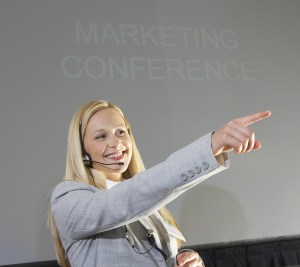
AdobeStock_129949762 (cropped at podium)

Some people like to have “action shots” that show them in leadership roles. To that extent, the image above works. However, pointing off to the side of the image takes the viewer’s eye in that direction as well, and away from one’s image and profile generally. It also makes this person look closed off rather than approachable. Further, the words in the background are distracting and do not add any credibility (compare, for example, someone on the Tedx stage). That said, an action shot that is professional and well-done can sometimes work well.

African American businesswoman

A lot of things are done well in this picture. It is generally well-cropped – it could be a bit tighter at the top – and the person is dressed professionally. However, she does not look happy in this shot, and the lighting on her hair and background is distracting. This is the most common type of picture that I see, i.e., one that makes the person look “good enough” to be happy with the picture but nonetheless does not show him/her in the best light (literally and figuratively). Some people don’t like to show their teeth, but you can smile more with the eyes in that case.

The above picture has the same issue with the distracting lighting in the background, although the lighting on the individual is better. This woman has chosen to have her hand in the picture, which sets it off as a more individualized shot and may be appropriate for certain fields where someone is asked to connect with people emotionally. For example, a therapist or a fiction writer may benefit from an image like this. By contrast, a litigator who needs to show an ability to meet challenging situations head on would not want to have an image that is too “approachable” or “soft.”

sailing man captainsailing man captain

Some people like to highlight their hobbies in LinkedIn profile pictures. Here’s my response. First of all, if you crop too closely (first image of two), you lose the entire point of the picture, and the various design elements end up looking distracting. This is the same point I would make to those who put up a photo with another individual cropped out of it (such as a shot at a wedding, with a spouse or significant poking into the side or corners of the image). The resulting image is similarly distracting and does not communicate that you are a serious, focused candidate.

In general, being too dressed down or too dressed up (think tuxedo for men, for example) may also give the impression that you are not willing to adapt yourself to a work environment but instead have your own agenda which will always or often trump the employer’s. So only if (1) one has an independent source of income, and LinkedIn is not a significant source of career or business leads or (2) these details are actually related to one’s career or business (e.g., if the man above were involved in marine work), would such a LinkedIn profile picture make sense. This is where the “LinkedIn is not Facebook” distinction comes into play. LinkedIn is about work, not pleasure, so wear your work face (presentation, wardrobe, etc.)

I should add that if you look closely at the man’s face, the top half of his face is in shadow and the bottom half is in sun. Once you notice this element of the photograph – as some of your LinkedIn viewers will do – the uneven lighting is quite distracting and casts a soft shadow (pun intended) on your attention to detail. In this image, it is not as pronounced as in other photographs I have seen.
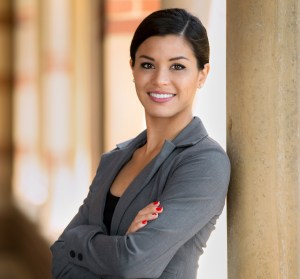
Beautiful young adult lawyer business woman professional in a suit at the courthouse

There is a lot I like about the shot above. It is clean, interesting and engaging. But don’t miss little details. The red nail polish, that is, has got to go. It is out of character and distracting, and it shows a lack of attention to detail.

shutterstock_146589713 (resolve)

This is a good shot in many ways, although the person is not looking into the camera, and the cropping is quite close. In an artistic field (for example), this may be appropriate, but not in a corporate setting.

Asian man portrait

When I look at the above shot, I can’t help but wonder if the individual dresses like this all the time and if it conveys his “true self.” Not all of us need to be in suits, and some people prefer LinkedIn to express how they will show up every day. If that is your personal brand, then this sort of image may work. 

Waitress serving food to visitors

In this shot, the person’s shoulders are off-kilter, which is distracting and could subtly take away from her credibility. The background is also overwhelming – especially the lights – as is the lipstick. If this person were my client, I would suggest she try again with a new shot.

woman with brunette hair standing posing

For this last one, I would say watch the sleeveless look as well as the posture and “pout.” Again, LinkedIn isn’t Facebook. Would you wear it for a meeting with the CEO? If not, it’s not the right look.

Anne Marie Segal is a career and leadership development coach, author, resume strategist and member of Forbes Coaches Council. She is founder of Segal Coaching, author of Master the Interview: A Guide for Working Professionals (available on Amazon.com) and a frequent public speaker in New York, Connecticut and beyond. 

Image credits above: Adobe Images.

What Does Your LinkedIn Photo Say About You? Beyond “Looking Good,” What Story Are You Telling?

As an executive coach and writer, I help people tell their own professional stories and present themselves in the best light.

Among other ways of interacting nowadays, social media is one of the key places we tell our stories. In the professional context, for many of us, a hub of such interactions is LinkedIn, and a personal photo serves as the centerpiece of any well-crafted LinkedIn profile.

Yet many of us give surprisingly little thought to our photos beyond whether they make us “look good.”

I speak from the heart on this one. The idea of using your profile picture as a means of communication, rather than simply a mug shot, is in my blood.

As an executive coach and writer, I help people tell their own professional stories and present themselves in the best light.

Among other ways of interacting nowadays, social media is one of the key places we tell our stories. In the professional context, for many of us, a hub of such interactions is LinkedIn, and a personal photo serves as the centerpiece of any well-crafted LinkedIn profile.

Yet many of us give surprisingly little thought to our photos beyond whether they make us “look good.” Hair OK? Check. Don’t look old or fat? Check.  What little thought goes into the analysis – as I often find with friends or clients who ask me to review their photos – is not about expressing a personal brand but rather simply not embarrassing ourselves.

I speak from the heart on this one. Before attending law school (and completing a 15-year career as an attorney that led to executive coaching), I was an art and photography major, and I worked in several art-related settings, putting up “new masters” on the walls of museums, galleries and other locations. The idea of using your profile picture (or any other image) as a means of communication is in my blood.

Beautiful young adult lawyer business woman professional in a suit at the courthouse

I want to impart that knowledge to you, and I would like to do it in stages. Knowing that the best way to teach is to show, rather than start with my analysis of the images in this post, I will let them sit with you for a while. Draw your own conclusions, and feel free to post in the comments about what stories you believe these images tell and whether they appeal to you. Here are some ideas to get you started.

What impression do you have of the person in each of Images 1, 2 and 3?

Would you want to connect with him or her on a professional or personal level?

Does the cropping of the image change how the story is told?

If you saw this image, as a viewer, what recommendations would you make to improve it?

I will check back in next week with more thoughts. Thanks!

anne-marie-segal-2016-photo


Anne Marie Segal is a career and leadership development coach, author, resume strategist and member of Forbes Coaches Council. She is founder of Segal Coaching, author of Master the Interview: A Guide for Working Professionals (available on Amazon.com) and a frequent public speaker in New York, Connecticut and beyond. 

Image credits above (other than of me): Adobe Images.

On Forbes: 10 Professional Hurdles that Sabotage Your Networking Efforts

Everyone knows networking is the critical piece of the professional puzzle. Our career, business and job search goals depend on it.

Back in the day, you could put that aside, work hard and have a career for life. But that time has passed. In short, while “who you know, not what you know” has always been the ticket into the upper echelons, the need to network has rippled out to every single one of us. From CEO to student, we all need a strong base of support, not only to advance our careers but also to maintain the advances we have made.

So what if you are not great at networking? What then?

Up today on Forbes.com, my fourth article at the site and second in a series about business and career networking for people who find it a struggle…

Black executive shaking hands with female colleague

“Everyone knows networking is the critical piece of the professional puzzle. Our career, business and job search goals depend on it.

Back in the day, you could put that aside, work hard and have a career for life. But that time has passed. In short, while “who you know, not what you know” has always been the ticket into the upper echelons, the need to network has rippled out to every single one of us. From CEO to student, we all need a strong base of support, not only to advance our careers but also to maintain the advances we have made.

So what if you are not great at networking? What then?”

Read more at Forbes.com or check out my prior article with insights from J. Kelly Hoey and Dorie Clark (via Kathy Caprino), “Introverts: Creating a Network that Works for You.”

Anne Marie Segal is a career and leadership development coach, author, resume strategist and member of Forbes Coaches Council. She is founder of Segal Coaching, author of Master the Interview: A Guide for Working Professionals (available on Amazon.com) and a frequent public speaker in New York, Connecticut and beyond.

Image above: Adobe Images.


A Career Coach on a Snow Day: Grit

As a snow day gives you time to reflect on what you want for your life and career and (for many of us) what you want to pass on to the next generation, I was thankful for the snow.

Red plastic shovel with black handle stuck in fluffy snow.

Here’s a quick thought about snow days from a career coach and mom, as the East Coast is being pummeled by Blizzard 2017, the snowmaggedon or whatever we are calling it today.

As a snow day gives you time to reflect on what you want for your life and career and (for many of us) what you want to pass on to the next generation, I was thankful for the snow.

My son took the snow blower and cleared the driveway this afternoon, which shows grit. He doesn’t always have grit. In fact, as a talented yet distractable boy, it is a key skill that we know he will need to build over time, as it does not come naturally to him. So we try to create situations that require grit but will not overwhelm him, so he will be motivated to push forward.

Grit is as old as time and has become the new power skill, as it is needed in just about every life situation. Here’s some more about instilling grit in children and educating students about grit:

The Carnegie Foundation

The Atlantic

NPR

I think often about how we build grit as a world and within our own families. In particular, what can we do to help children appreciate the skills they need to serve as leaders in the future and “show up” the right way to succeed? Today, the answer fell from the sky.

Snow Day Grit - Snow Blower

Anne Marie Segal is a career and leadership development coach, author, resume strategist and member of Forbes Coaches Council. She is founder of Segal Coaching, author of Master the Interview: A Guide for Working Professionals (available on Amazon.com) and a frequent public speaker in New York, Connecticut and beyond.

First image above: Adobe Images.
Second image copyright 2017 Anne Marie Segal. All rights reserved.


On Forbes: The Emotional Life Cycle of a Major Career Transition

Clients often ask for a roadmap for career transitions, whether they yearn for more meaning at work or have other motivations. While I can ask the right questions to uncover their passions and talents and how these intersect with the marketplace, paths taken vary widely and can be entirely unexpected.


Eco concept

Jake worked for five years as a transactional attorney and then turned to real estate, managing his family’s portfolio of rental properties. From there, he launched a third career as an artist, painting large-scale murals for corporate offices and collectors.

As an executive coach, I have a front row seat to major professional transitions of brave souls such as Jake. Clients often ask for a roadmap to make such a change of their own, whether they yearn for more meaning at work or have other motivations. While I can ask the right questions to uncover their passions and talents and how these intersect with the marketplace, paths taken vary widely and can be entirely unexpected.

Please click on the image of the caterpillar below for the link to the rest of this article, originally published on Forbes.com.

Monarch Butterfly Caterpillar On Milkweed

Anne Marie Segal is a career and leadership development coach, author, resume strategist and member of Forbes Coaches Council. She is founder of Segal Coaching, author of Master the Interview: A Guide for Working Professionals (available on Amazon.com) and a frequent public speaker in New York, Connecticut and beyond.

Image credit: Adobe Images.