Interview Prep – Book & Checklist

Most of my readers know that I have been busy “creating things” (and even started learning Italian) during the pandemic, but I have not posted anything new on this blog for quite a while!

Since my last post, some important aspects of my coaching practice have shifted, but in other ways it has stayed the same.

One change, of course, is that I have continued to refine my approach over the last two years. Serving as the Facilitator for the PODER25 program of the Hispanic National Bar Association in 2020-2021 afforded me incredibly rich new insights, and more recently I have also been facilitating cohort programs of my own.

Another happy development is that I have been humbly informed by a growing number of clients that they reached out to me as a coach on the basis of reading one or both of my books. A few have even held it up on the Zoom call to show me their flagged and dog-eared copies. What an amazing thing for an author to hear, and I am incredibly grateful!

Master the Interview, available on Amazon and other bookseller sites worldwide.

Among these and other changes (the pandemic included) since I published my first book – Master the Interview – in 2016, I have decided to release a second edition. If you have anything you want to share with me about the book (and interviewing) in the meantime, feel free to reach out.

The Second Edition will include expanded discussions of:

  • Behavioral interviews
  • Compensation negotiations
  • Diverse viewpoints toward the interview process
  • Interviewing for multinational corporations
  • Interviewing with a board of directors
  • And more!

Here’s a lovely image of Master the Interview making its way down the Rhine River in Switzerland, courtesy of a friend and former colleague who read it cover to cover.

In honor of the upcoming Second Edition and my restarting this blog, I am sharing my GC Interview Preparation Checklist (which is also very helpful for other C-Suite and senior roles):

Thanks all!

Nine Ways to Accelerate Your Career Growth and Job Search as a Chief Legal Officer or General Counsel

Many of my clients are Chief Legal Officers or General Counsel at public or private companies who want to know how to (1) expand the growth runway in their current role and/or (2) find a new role that better suits their growth trajectory. Often these two goals go hand-in-hand, especially if you can initiate further career-enhancing opportunities within your current organization while opportunistically being open to new roles externally. If you are a Chief Legal Officer or General Counsel and at a similar career juncture, here are some insights that may help you accelerate your career growth and/or job search.

Many of my clients are Chief Legal Officers or General Counsel at public or private companies who want to know how to (1) expand the growth runway in their current role and/or (2) find a new role that better suits their growth trajectory. Often these two goals go hand-in-hand, especially if you can initiate further career-enhancing opportunities within your current organization while opportunistically being open to new roles externally.

In other words, often it behooves you to do both: look for internal and external opportunities rather than rigidly treating internal growth and job search as an either/or proposition.

Portrait happy, smiling business man outdoors

If you are a Chief Legal Officer or General Counsel and at a similar career juncture, here are some insights that may help you accelerate your career growth and/or job search:

      1. Get plugged into the right networks. For example, many veteran CLOs and GCs take active steps to seek out potential successors. If you are on their radar screens as a contender, whether you are an internal or external candidate, you will be first in line when the transition occurs. Beyond that, remember that you will not only need to convince the CLO or GC who is currently in the role but also appeal to the CEO and Board of Directors.

      2. Get on the radar screen of recruiters. As an ancillary network-building activity, take the time to get to know the recruiters who are commonly involved with General Counsel searches. Recruiters work for companies, not candidates – a distinction that it serves you well to understand! – and therefore may not be actively pursuing you or overly responsive (although they should not simply ignore you) unless they have a role that fits.

        It’s your job to get in front of recruiters without becoming a pest (respect their time!), continue to be polite and responsive yourself (even if you feel desperate or entirely overwhelmed at any given moment) and make sure that you have done the work to polish and present yourself as a compelling candidate rather than expecting the recruiter to figure out what to do with you.

      3. Dust off your resume, LinkedIn profile and interviewing skills. If you do intend to conduct (or find yourself in) a job search, or you wish to target a key promotion, make sure you have put yourself together as a compelling “package.” (This echoes what I listed in #2 above.)

        At the very least, review your resume to make sure it reflects your current accomplishments and communicates them in a clear manner. Not only does this help you have a “better” resume, but it also gives you a lens to focus on the value you have brought to your organization and what you can expect to contribute in the future. Similarly, if you have not interviewed in over ten years, you should seek to sharpen your executive presence and interviewing skills, whether you are interviewing with your own board of directors (for an internal promotion) or a new one (for an external role).

      4. Know how Chief Legal Officer and General Counsel searches are conducted. If you wish to be viewed as the top candidate, it behooves you to know what your audience is looking for. Admittedly some companies do not have a good handle on their own hiring priorities, even for a role as important as CLO or GC, and you will need to fill in the gaps for them (or avoid taking those roles). Others are cognizant of best practices and conduct a highly organized and effective search.

      5. Know what Boards of Directors, CEOs and other senior management want from their Chief Legal Officers and General Counsel. Whether it is through informational interviewing, informal discussions, mentoring or your own due diligence, make sure that you understand what is expected of a CLO or GC while serving in the role.

      6. Consider adjacent roles. Within your own company or at a new one, consider how you can take on business and other roles that will expand your range of influence and subject matter domain. Examples abound and include running a business line within the organization, serving on the board of a branch or subsidiary, heading up government affairs, leading a high-profile initiative or serving as an interim in another C-Suite role, such as Chief Operating Officer, Chief Human Resources Officer, Chief Sustainability Officer or even Chief Executive Officer. If you need more robust industry or subject matter expertise, emotional intelligence or caché to take on such a role, go out and get it!

      7. Envision yourself as a C-Suite leader, not just a lawyer. Just as you need to do the work to know your value proposition and polish your brand before speaking with a recruiter, you also need to do the work to wrap your head around the business and how you can add value as a member of senior leadership. Invariably my clients who see themselves in this light – rather than “the lawyer in the room” – are the ones who are more successful at attracting sponsors and other upward mobility and achieving marketability in their careers.

      8. Enlarge your circle of possibilities while respecting your own guiding principles. Know what your priorities are and plan your career around that. For example, if you feel that you need to stay in the Chicago or Nashville area for another five years, understand how that affects your career choices and target your decisions on where to build out your expertise to match the market. Ask yourself: how wide of a circle can I draw so that I don’t foreclose opportunities while continuing to meet my own personal commitments and values?

        For example, if you are currently in Nashville but ultimately want to return to Boston, Miami or San Francisco, can you create or strengthen ties to that target city now that will facilitate your transition when the time is appropriate? Alternatively, you may decide that a top role in Wisconsin, Indiana or Michigan is sufficiently close to the Chicago area to honor your commitment to stay local, depending on the reason that you have made this a priority. Even if you are truly open, geographically or otherwise, make sure that the role continues to meet your other priorities.

      9. Build out your reputation beyond your current company. Don’t become so focused on the “problems at hand” that you forget to build out your leadership credibility and network beyond your current organization. Set aside some time (for example, 5% to 10% of your total professional energy) to make this happen, and choose your engagements well so that they are meaningful to you and impactful on the community or other target audience.


Anne Marie Segal
 
is an
executive coach, resume writer and author of two well-received books on interviewing and career development. She served as a corporate attorney for 15 years, including roles at White & Case LLP and a prominent hedge and private equity fund manager, before launching her coaching practice. She is also currently serving as the Conference & Workshop Facilitator for PODER25 General Counsel pipeline initiative of the Hispanic National Bar Association and HNBA Via Fund.

Anne Marie Segal

Based in Connecticut not far from New York City, Anne Marie partners with clients internationally on executive presence, impactful communications, graceful transitions and other aspects of professional and personal development. 

First image above: Adobe Images.

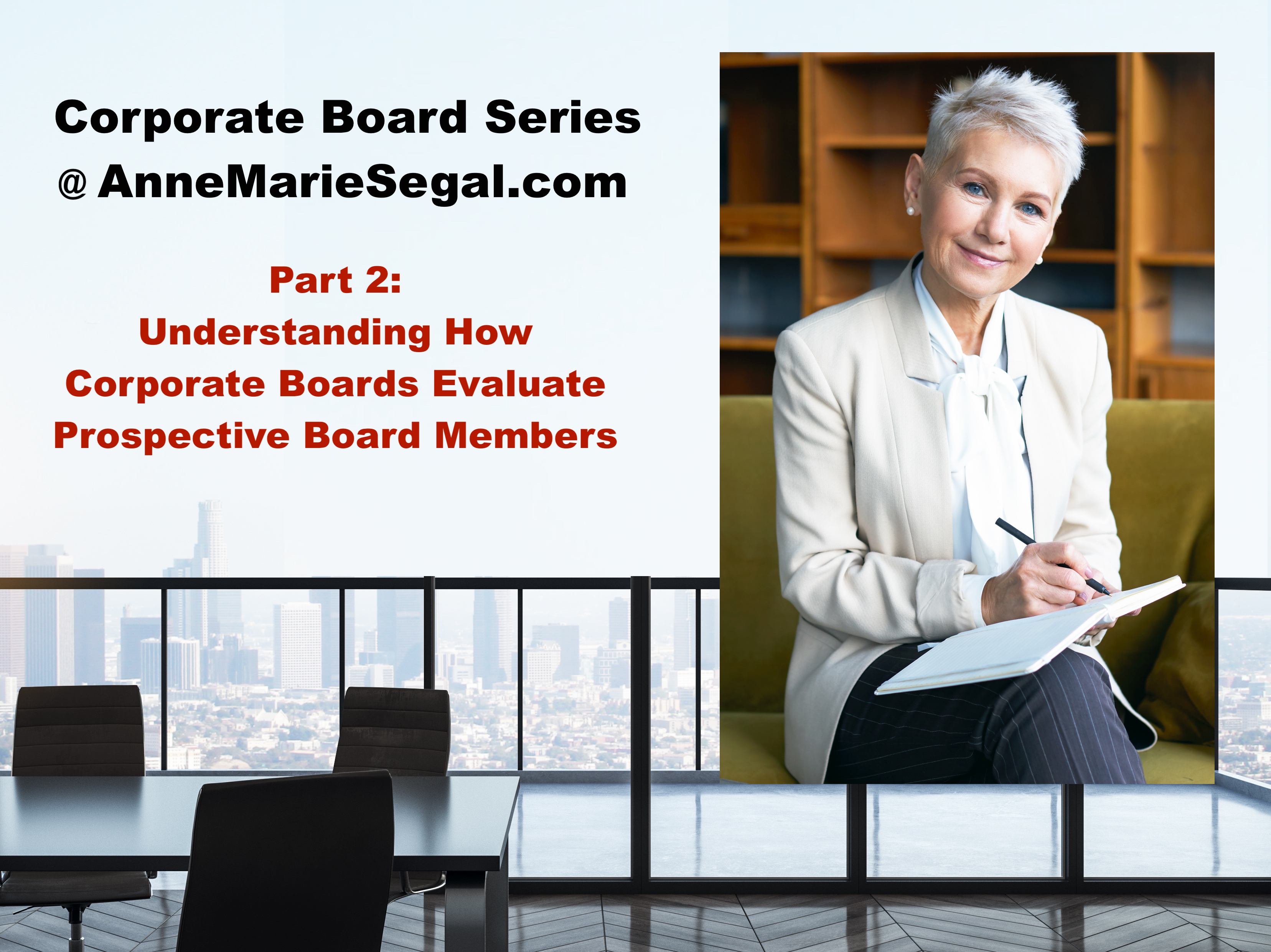
Understanding How Corporate Boards Evaluate Prospective Board Members: Corporate Board Series, Part 2

In my prior article on corporate boards, I explored how you can build out and articulate your vision for board service. This time, I will take the other perspective. What do (and should) corporate boards have in mind when they evaluate prospective board members?

Corporate Board Series, Part 2 - Evaluation Process - AnneMarieSegal.com.jpg

In my prior article on corporate boards, I explored how you can build out and articulate your vision for board service. This time, I will take the other perspective. What do (and should) corporate boards have in mind when they evaluate prospective board members?

The list of board-ready qualities is long, and in almost every case it will include:

  • culture fit
  • expertise
  • thoughtful engagement
  • integrity

A company might have different ways to express the above, and it will often add other important factors to the list, such as international experience. As a concrete example, here is the list of independent board candidate qualifications for Colgate-Palmolive.

Let’s explore each of these four core qualities in more depth:

Culture Fit. Just as a prospective employer is looking for candidates who would be a fit for the culture of the organization, so is the board of directors. At the same time, you need to be a fit for the specific culture of the board itself.

Here is an article by three leaders in board recruitment at SpencerStuart that speaks further to the importance culture fit on boards, including ways to help define this elusive concept. As a prospective board member, you will be well served to learn as much as you can about the board and company culture – including who are the heavy hitters and how they drive the board conversation – so you can both appeal to the board that you are a fit and determine (for yourself) that you actually are.

Many nominating/governance committees are (thankfully) moving away from using “fit” as a proxy for compiling a homogenous board. Diversity continues to be a priority for board refreshment among many of the surveys of board trends.

Expertise. Another key aspect boards use to evaluate candidates is their expertise across the range of areas that the board would need to span. Financial acumen is clearly one area of expertise that is in high demand, but it is not the only one. Leadership expertise is also clearly important, and this couples with an ability to appreciate (and put into practice) the role of the board as providing oversight, not “doing” the work of running the company.

As Betsy Atkins illuminated in her interview with Alexander Lowry on Boardroom Bound (see episode #30), board candidates should think about where they can add the most value in differentiated expertise. For example, she notes that you may have functional skills (like financial, marketing or product expertise),  specific industry knowledge (such as deep domain expertise in steel or financial services) and/or stage-of-company expertise (such as with taking early-stage companies public, turnarounds or large-cap global multinationals).

It also pays to do some research into how your functional role can add to the board composition. For example, if you happen to be a General Counsel (GC) and seeking a board role, as many of my clients are, you will want to be able to articulate what General Counsel can add to boards (even if the company already has a GC, as they likely will). Since often the value a GC brings to the company cannot be easily expressed without an understanding of the big picture – which is harder than saying you brought revenues from $X to $Y – finding another way to get your message out there can help boost your candidacy while adding to your cache (#4 below).

For example, here’s an article in Modern Counsel about Audrey Boone Tillman, EVP and GC of Aflac, that highlights both her work on corporate governance and regulatory compliance and her appreciation of cultural differences in a very readable manner. It would be tough to communicate the same breath, depth and range of compatible skills in a few bullet points or sentences on a resume or board biography.

Articles such as this one demonstrate not only individual skill sets but also what a candidate brings to the table as a “full package.” (Note: I am not commenting on Ms. Tillman or anyone else’s motivation for the article, simply speaking to its effectiveness.) For executives who have access to company-generated or external media coverage that can help tie together the threads of their careers, it is worthwhile to invest the time to create a compelling and cohesive career narrative.

Thoughtful Engagement. Boards consistently state that they want members who will be actively engaged in meetings and are not afraid to ask the tough questions. One way to demonstrate your potential for engagement as a board candidate is to be apprised of the top issues facing boards today. (Note: For public companies, the NACD public company governance survey offers key insights, and many of these translate for private companies as well.) Another is to have and make known a genuine passion for the company itself and its customers. Further, as most board recruitment is through connections, being known as someone who is actively engaged in your current role(s) will position you as an attractive candidate for a board.

Integrity. With the increased scrutiny on boards, it also goes without stating (but should be included for completeness) that boards are placing greater value than ever on a board candidate’s integrity. In most cases, in fact, this is the most important quality a board member can have.

Copyright 2020 Anne Marie Segal. All rights reserved.


Anne Marie Segal Post Banner

Anne Marie Segal is an executive coach, resume writer and author of two well-received books on interviewing and career development. She served as a corporate attorney for 15 years, including roles at White & Case LLP and a prominent hedge and private equity fund manager, before launching her coaching practice. 

Based in Connecticut not far from New York City, Anne Marie partners with clients internationally on executive presence, impactful communications, graceful transitions and other aspects of professional and personal development. 

To join her mailing list, click here.


Four Leadership Traits of High-Performing General Counsel (Women GC’s Speak)

This week I attended “Women GC’s Speak,” a New York City Bar Association panel moderated by Debbie Epstein Henry. Among the four General Counsel panelists, the leadership message was exceedingly clear:

Take on challenges,

find opportunities,

push yourself to be a little uncomfortable,

fill leadership gaps, and

figure it out.


Women GC's Panel image - 11-6-19 - NYC Bar.jpg

Panelists and moderator, from left to right: Ayssa Harvey Dawson, Cari Robinson, Debbie Epstein Henry (moderator), Romy Horn and Sonia Low. Photograph copyright 2019 Anne Marie Segal. All rights reserved.

Here are four specific insights the panelists shared that echo and underscore the coaching work I do with my General Counsel clients:

Romy Horn, General Counsel of the W2O Group, suggested that among the business aspects a law firm attorney (for example) needs to learn to transition into a GC role, there is one key aspect that many would-be General Counsel fail to grasp:

“Finance. [To be a trusted advisor and excel in a GC role], lawyers in companies need to understand the financial aspects of what they are doing.”

Sonia Low, VP, General Counsel and Secretary of the Jacob K. Javits Convention Center, reminded the audience that GCs are valued not for reciting the law but for helping senior leaders and others meet their business goals. To be a problem solver and transcend the legal function, don’t be afraid to ask:

“Can I come with you to these conventions? I’d like to meet more CEOs and CFOs, so I can better understand what drives them.”

Ayssa Harvey Dawson, General Counsel, Head of Legal, Privacy and Data Governance of Sidewalk Labs, shared that too many attorneys are caught in the “qualifications” trap and talk themselves out of opportunities as a result.

“Qualifications are subjective. When my last company was bought, I thought to myself, what do I want to do next? What I have learned from that is to never be afraid to embrace change.”

Cari Robinson, Executive Vice President and General Counsel of Revlon, echoed that advice, adding that you are never going to know everything about a business, especially if you change industries, so:

“You can’t be bashful about asking people to slow down and explain things to you.”

Robinson also shared two essential factors that have helped her succeed as a GC:

first, her global litigation background, which showed her “a little piece of a lot of things” that collectively taught her “how to think about business” and made her a very nimble attorney, ready to face any opportunity, challenge or crisis situationand

second, her evolution from a focus on building her own career to supporting and building out her team.

For more information about this panel and the sponsoring committees, click here.

Anne Marie Segal is a career and leadership coach, writer and resume writer for attorneys, executives and entrepreneurs. In her practice serving lawyers, she coaches General Counsels, law firm partners, counsel and associates, as well as government, academic and non-profit attorneys.


General Counsel and Other Lawyers as Business Partners – Building Vision, Capacity, Judgment and Leadership

To succeed as General Counsel, you need not only to build relationships and move outside of what may be your comfort zone – a lawyer with excellent substantive legal skills – but also position yourself as a strategic member of the leadership team. Enclosed is a list of articles to help you explore and master the expanded General Counsel relationship.

Eight Core Qualities of General Counsel and How to Achieve Them is my most-read article on this blog, receiving many hits per day and more than 2,500 views since it was published in the late summer of 2016. (Click here to access the article.)

As a coach, I often receive requests from General Counsel, Assistant General Counsel and other in-house attorneys – as well as law firm partners and others who wish to obtain those roles – to coach them on building their capacity and visibility as a business partner within an organization.  Both of these aspects are important – exercising the right proactivity, judgment and skills and being recognized and rewarded by the Board and senior management for such contributions. This involves not only building relationships and moving outside of what is commonly called one’s comfort zone – a lawyer with excellent substantive legal skills – but also learning how to position oneself as a strategic member of the leadership team.

AdobeStock_131225997 (woman GC or CEO).jpg

To succeed as General Counsel, you need not only to build relationships and move outside of what may be your comfort zone – a lawyer with excellent substantive legal skills – but also position yourself as a strategic member of the leadership team.

I intend further explore the expanded General Counsel role in the coming months, so please subscribe to my blog or sign up for my mailing list if this is a topic that moves you. In the meantime, I have started to compile a list of articles around the web from recent years that have addressed the evolving General Counsel role, which I am posting below to help you explore and master the expanded General Counsel relationship.

If you hold a CEO, CIO, CFO, COO, CTO, General Counsel, law firm or other role and would like to post another resource in the comments or join the conversation, I appreciate your input.

I may update this list from time to time. Thanks in advance!

Attorneys – General Counsel and In-House
Vision, Judgment, Capacity Building and Leadership

Eight Core Qualities of Successful General Counsel and How to Achieve Them,” Segal Coaching Blog, Anne Marie Segal.

So You Want to Be General Counsel? How to Maximize Your Chances,” ACC Docket, David M. Love III, Mark Roellig.

Do Lawyers Make Better CEO’s than MBAs?,” Harvard Business Review, by M. Todd Henderson

The General Counsel as Senior Leader: More than “Just a Lawyer,” Korn Ferry Institute, John Amer.

What GCs and CCOs Can Learn from Each Other,” Thomson Reuters, Thomas Kim.

An Open Letter to GCs and Law Firms,” ACC Docket, Daniel Desjardins.

General Counsel: Guardian and Conscience of the Company,” Forbes, Mark A. Cohen.

The Rise of the General Counsel,” Harvard Business Review, Ben W. Heineman, Jr.

General Counsel’s New Role: Business Strategist,” Forbes, Brian Jones.

Anne Marie Segal is an executive coach, writer, resume strategist and former practicing attorney (including as a law firm partner and Deputy General Counsel of a private equity and hedge fund). The majority of her clients are senior attorneys, and she has coached hundreds of professionals across law, finance, engineering, technology, marketing, non-profits, government and other fields.

Anne Marie is also author of Master the Interview and the newly published Know Yourself, Grow Your Career: The Personal Value Proposition Workbookavailable at Amazon, Barnes & Noble and other retailers. 

Click on a sharing option below to share this post on LinkedIn, Twitter or other social media sites. Please leave a comment if you want to join the conversation or share an article, video or other resource for the list.

Image credit: Adobe Stock.

8 Core Qualities of Successful General Counsel and How to Achieve Them

If you are currently in a GC role and want to raise your game (or emphasize your value proposition in an upcoming interview), or if you are looking to become a GC from a law firm or in-house counsel spot, here are eight qualities that you must cultivate to be a successful General Counsel.

AdobeStock_52598491 (GC:CEO).jpg

Becoming a General Counsel (GC) or Chief Legal Officer (CLO), or making a move to a more senior GC or CLO role at a more prominent company, is not simply a matter of rising through the ranks or toiling away for years at a law firm and then deciding one day that you would like to throw in your hat for the position. Years ago, longevity in the legal field, motivation to fill the role and a projection of confidence may have been sufficient to mint a new GC or CLO, but the world has changed and the role of General Counsel has evolved along with it.

In today’s complex and competitive marketplace, successful General Counsels and Chief Legal Officers need to excel across a range of key, identifiable areas (spelled out below) and demonstrate their ability to be a key asset to their companies, helping make or break their long-term success. Often,  GCs and CLOs also run a legal staff and provide leadership and management of other attorneys, compliance professionals and/or administrative personnel. In addition, they may be members of an executive team and collaborate with cross-functional groups to give input on diverse areas such as product development and marketing.

Successful GCs need to excel and execute across a range of key, identifiable areas.

If you are currently in a GC role and want to raise your game (or emphasize your value proposition in an upcoming interview), or if you are looking to become a GC or CLO from a law firm or in-house counsel spot, here are eight core qualities you must cultivate to be successful in this key role.

Know the business inside and out.

1.  Understand the big picture of the business and industry. This point is emphasized so often that the words “big picture” begin to sound cliché, but it is nonetheless #1 on the list of attributes for a successful General Counsel.

The most effective GCs focus on the business first and understand that the legal aspects of any deal, regulatory requirement or dispute must be viewed from the lens of the business goals. (In the case of a non-profit organization, the “business” is the “mission,” and the same principals apply.) This point is especially relevant for attorneys who are aiming to switch from a law firm setting directly to a General Counsel role, as they may not have been as close to the day-to-day needs of the business while working on high-level matters such as acquisitions, litigation or other big ticket items.

To facilitate your top-down understanding, you should ask yourself questions such as:

Corporate Matters:  How does the current acquisition, joint venture, contract or other transaction create value for our company? What risks or implications does it hold, what failures are possible (and how likely are they to happen) and how does it fare in the overall cost-benefit analysis? How will we integrate what is new into what we already have, and who needs to be on board? What should we be thinking about that hasn’t yet been raised?

Compliance: What is the impact and true cost of compliance with current and proposed regulations, and how can we effectively meet our obligations or, if appropriate, obviate the need to comply?

Disputes and Litigation: What is the best approach to meet our short and long-term objectives in the case of a dispute? What unintended consequences can result from our range of possible litigation strategies and how could they affect our business? Is there a better way to get to the right answer?

Marketplace: Are there disruptions in our industry that present opportunities or threats, legal or otherwise? How should we address them and/or get ahead of the game?

Generally: How else can or should we be pro-active in any areas that could have an impact on our business or legal strategy and what economic, political, technological, industry and cultural developments should we monitor? How often? Whom shall I engage (in meetings, conversations and otherwise) in order to stay informed and make the best decisions on that front? 

And personally, you should ask yourself:

How does my role as an executive and attorney fit into the big picture? What do I bring to the table, and how can I bring more?


A key part of understanding the big picture is having a strong handle on financial matters. Understand and take ownership of P&L (even if at first it is only for a single project, or you have “derivative” or shared ownership), speak about your accomplishments in terms of the value you add (money in or costs and risks avoided) and know how to maximize the return on your company’s investment in you and your team.

2.  Demonstrate good judgment. Gain a reputation for making the right calls and connecting the dots with limited information to help your team make it to the finish line on deadline and without any snags. (Note: The best way to cultivate good judgment is by rolling up your sleeves and practicing decision-making under pressure – which may mean stepping out of your comfort zone – to gain exposure, confidence and feedback. It can only learned by doing.)

Good judgment is sometimes called a “sixth sense” or an “ability to see around corners” from business and legal perspectives. Whatever you call it, you cannot be an effective GC without it.

Talk like a business person. Not a lawyer.

3.  Don’t talk like a lawyer. Talk like a business person. Sometimes this is called “talking in English rather than legalese,” but it goes beyond that. The best GCs can prioritize and communicate the key business points and know how to signal and address potential legal issues without dragging business leaders into the fray or wasting their time on concerns that the lawyers need to work out among themselves. They also know how to gently reign in business folks who get ahead of themselves by ignoring those legal risks with which they actually should concern themselves, including business risks that are masquerading as legal risks.

One of the best ways to learn how to talk like a business person (or, more specifically, unlearn how to talk like a lawyer) is to spend time with them, hear them converse, get into their heads and internalize their concerns. In other words, the road to GC is not paved by putting your head down and doing your work. Like good judgment, you can only learn to communicate better by doing.

The road to GC is not paved by putting your head down and doing your work.

4.  Be humble. At the end of the day, the legal function is a support function. Yes, lawyers help steer the boat, but a successful GC understands that sometimes business leaders make decisions that do not follow the best advice of counsel, taking on what a “reasoned head” might decide is too much unnecessary risk. Your potential recourse in this situation, if you disagree with your business counterparts on whether your legal advice is required or simply “advisable,” is fourfold:

(a) you could move over to the business side and do a better job yourself,

(b) you could leave (if you feel consistently disrespected or are concerned about ethics or the longevity of the company or your role);

(c) you could find ways to strengthen your own and/or your team’s standing within the organization so that your advice is taken more seriously (if not always followed); or

(d) you could hold your ground (withholding legal approval) and/or escalate your concerns.

Save the fights for when they really matter, not for when they help you feel vindicated, save face or appear to know best. Having a reputation for “resistance” to business needs is not a good long-term strategy at any company, as it undermines your authority. If you feel that you are too often at loggerheads with your business folks, the best strategy may be to move on to a company that you believe has better business practices or is a better match for your own risk-tolerance levels. (Conversely, if you are at a company that loses out on opportunities because it never takes sufficient risk, in your opinion, you may also be well served by seeking a stronger fit.)

5.  Take leadership roles. Don’t wait for opportunities to present themselves; you need to create them. This means getting in front of the Board of Directors, President or CEO whenever appropriate and possible, making presentations to industry or key clients, spearheading/overseeing important projects and making yourself known as a person of vision and action within the company and outside of it. The best way to get tapped for a GC role, or increase your impact if you are already in one, is to be (and create the reputation of being) someone who effectively leads, mentors, sponsors, motivates, teaches and influences others. In short, make leadership a centerpiece in your professional mission and personal brand.

Make leadership central to your professional mission and personal brand.

6.  Cultivate your political capital. Form relationships and maintain consistent lines of communication with key people inside your company, across your industry and beyond. The greater your political capital, the more you can leverage your current role and be considered for positions with increasing responsibility. If you are a law firm partner or counsel hoping to transition in-house, increase your network of in-house players and business leaders, so that you understand their perspectives and have them in your corner when the need arises. In addition, if you have raised your political capital in the marketplace, you will present as a stronger candidate if and when the opportunity for a lateral move or promotion becomes available.

7. Learn to manage others and delegate work. There may be many GCs and CLOs who have taken on the role without knowing how to manage a group of talented professionals and assign the right tasks to the right players, but to build a successful career as a General Counsel, you will need to guard your own time while managing the performance and workload of your team (which may include outside counsel). 

8.  Have a solid and broad range of substantive legal skills. Increasing and broadening your substantive legal knowledge is only one piece of the GC equation. I address it last because while having a well-developed legal “head” and intuition is a baseline, legal knowledge alone is not sufficient to be an effective General Counsel.

The problem with many legal roles is that an attorney becomes siloed (or niched) into a particular area of practice, whether it is litigation, contracts or otherwise. To be effective, GCs need to address directly or oversee all legal needs of their company or organization. This means they may need expertise or at least a passing knowledge (to “know what they don’t know and should find out,” as the phrase goes) in commercial matters, corporate governance, employment, litigation, real estate, tax, executive compensation, compliance and risk management, in varying orders and degree.

If your goal is to raise to the level of General Counsel or (if currently a GC) become a bigger fish or swim in a bigger pond, you should conduct what I sometimes call a “gap analysis” to determine what is missing in the mix, then work on how you can deepen and round out your skills. Not only will this make you a stronger GC candidate, it will make you a better lawyer and add to your ability to provide judgment in a crisis and day-to-day.

Find and close any gaps in your substantive legal skills. 

Clearly the role of a General Counsel is dynamic and requires a broad range of talents and skills that cannot all be captured in a short summary. Instead, treat these seven points as a roadmap, and feel free to leave me a note in the comments section with your own insights. For further reading, I also suggest “So You Want to Be a General Counsel? How to Maximize Your Chances,” published in the ACC Docket and also available here.

 
Anne Marie Segal is a career and leadership coach, writer and resume writer for attorneys, executives and entrepreneurs. In her practice serving lawyers, she coaches General Counsels, law firm partners, counsel and associates, as well as government, academic and non-profit attorneys. 

© 2016 Anne Marie Segal. All rights reserved.
Image: Adobe Stock.
If you enjoyed this post, you may also like: