Introverts + Professional Networking: My Own Story of Networking with (and Finally Meeting) Dorie Clark

If you follow me on LinkedIn®, you might have seen yesterday’s post that, after years of following her work, I finally met a mentor of mine, Dorie Clark, in person. Coincidentally, during a coaching call today with a CFO client about networking, the story of how I first “met” Dorie became highly relevant to our conversation.

I put the word “met” in quotes above, because for a long time my interactions with Dorie were simply online conversations, virtual high-fives and back-and-forth comments, given the busyness of business that we all have come to call life. As my client and I were brainstorming this afternoon about ways she could build out her networking and thought leadership, the idea of leveraging LinkedIn naturally became part of the conversation.

With Dorie’s recent “Land Your Book Deal” workshop and last night’s dinner with her and follow conference participants fresh on my mind, I confirmed that yes, online networking certainly can work, if you choose to network with people who are good match for you and make the effort to grow the relationship. And yes, I do practice what I coach and have real-life examples of forging professional relationships online that emerge and take form offline as well.

After first hearing about Dorie and reading her work, I became an immediate and huge fan. Many months after that, I quoted her and J. Kelly Hoey (another bright light to watch and learn from!) in an article I published. When I went back to retrieve this article for my client, I was surprised (and also not surprised) to see that it is from 2 1/2 years ago!

Again, I am practicing what I coach: networking is not transactional. Identify key relationships that make sense to nuture and invest your time and energy there, because you find shared, evolving and long-term value in the connection. Don’t be in a hurry to see some “payoff.” The payoff, in many cases, is in the relationship itself.
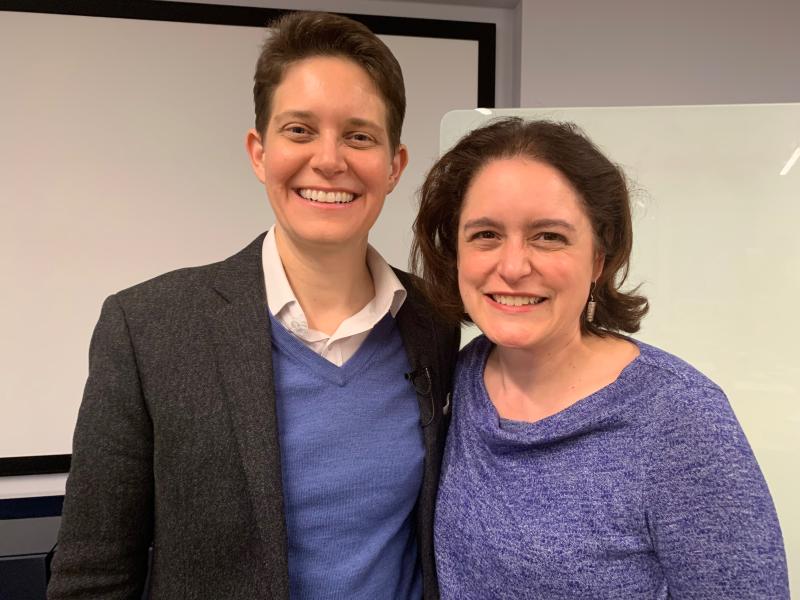
With Dorie

In case you would like to read the article in which I quoted Dorie and Kelly back in March 2017, I’m reprinting it below:

Introverts make better networkers.

That’s what J. Kelly Hoey, author of Build Your Dream Network, told a packed room of lawyers and investment professionals at the New York City Bar Association in late January of this year. After interviewing numerous sources for her book who are highly effective networkers, she realized that many of them self-identify as introverts.

The idea that introverts can truly shine at networking strikes many professionals – including many introverts – as a foreign concept. If they prefer being alone to lighting up a room and are driven more by introspection than connection, how can introverts be great at networking? After all, extroverts more easily strike up a conversation, keep it going and follow up with less fear. By their nature, they crave interactions with others. So how are they not the best networkers?

To get to the right answer, we need to be asking the right question, and that is: “What is the purpose of networking?” Effective networking, after all, is not an exercise in having the most Twitter followers or connections on LinkedIn. It is not, in fact, a numbers game at all. The goal of networking is to build an interconnected group (i.e. network) of individuals with whom you can create – over time and with meaningful energy invested – mutually beneficial relationships. A smaller network of more powerful relationships has infinitely more value than a so-called Rolodex of people who are weak contacts at best.

If you are looking for a place to start, remember that everyone already has a network. Everyone on the planet, in other words, has fellow alumni from high school, college, professional programs, work colleagues, neighbors, family, friends and/or other groups of people who form a network. Add to this basic network the people you may meet at yoga, tennis, church, the public library, nature walks, car shows, birthday parties or the myriad of other activities that may populate your day, and you may already have hundreds or even thousands of connections. If you start to actively associate with those in your existing network with whom you have a professional affinity, rather than envisioning networking as something that “other people do” or “only others do well,” you will make that first step toward actively creating an integrated network that works for you, rather than only belonging to a passive one created by default, not design.

The key to tipping the balance is to reframe the act of networking. It does not need to be a business-card exchange in a crowded event with strangers – something Kelly calls “random acts of networking,” which is generally ineffective – but it instead can be seen as an ongoing project of building relationships. By their nature, introverts are very thoughtful about how and with whom they communicate, so although they may not network in as many settings with as many people, they are more suited to creating a greater return for their ongoing efforts.

So how, as an introvert, can you effectively network in a non-threatening way?

Just as you would invest your money wisely, you can target your time invested to achieve the greatest return on such investment. This means, as I said above, that you first understand why you are networking so that it is a purposeful exercise. Are you building a network for a career transition that you foresee undertaking in the next 12 months, for example? If so, you will want to network with people who are in your target field or have undertaken similar transitions, who can help you along your way. Are you planning to write a book? You may wish to build a network of authors and experts in your area of writing, as well as others who are at the same stage in your writing journey, so you can support and share ideas with each other.

On a practical level, Dorie Clark, author of Reinventing You and Stand Out: How to Find Your Breakthrough Idea and Build a Following Around It and a self-proclaimed introvert, has great advice for other introverts who wish to grow their networks. As she offered in an interview with Forbes contributor Kathy Caprino: “There are plenty of new and interesting people to meet who already have some connection to you, so ask for suggestions from friends and colleagues about who they know that they think you should connect with.”

Connecting with warm contacts, in other words, is a good place to target your networking efforts as an introvert. As Dorie says, you will already have a starting point, and the common ground will allow you to build a professional relationship more quickly. In addition, if you grow a network through current connections, your target networking audience will be hand-chosen rather than arbitrary leads, so they are likely to be better matches in any case.

This emphasis on warm connections does not suggest that introverts should avoid conferences and other big-ticket events altogether. Rather, in their characteristically thoughtful way, introverts can carefully choose and plan a limited number of events that are likely to bring results and how to achieve them.

As I mentioned in my own book, Master the Interview: A Guide for Working Professionals, to network effectively, you need to show that you actually value the other person. Many people miss this crucial point, which is one reason so many introverts (as well as ambiverts and extroverts) have formed a negative impression of networking. They have been “networked to” rather than “networked with,” and (wishing to escape further uncomfortable interactions such as those in the past) have turned off to networking altogether.

Showing you value the other person by focusing on the relationship – and not what you can “get out of them” – can transform networking from what may feel or seem like a selfish, needy or transactional endeavor to a fundamental human connection among people who can enhance each other’s lives. With this end in mind, introverts, as well as extroverts, can create a network that works for them.

Anne Marie Segal is an executive coach, resume writer and author of two well-received books on interviewing and career development. She served as a corporate attorney for 15 years before launching her coaching practice, including roles at White & Case LLP and a hedge and private equity fund manager. Anne Marie is based in Stamford, CT and serves an international clientele. Her online learning platform is accessible here.

This article, other than the introduction, was original published on Forbes.com and is accessible here. Image above copyright 2019 Anne Marie Segal. All rights reserved.



Should You Attach Your Resume to Your LinkedIn Profile?

Have you often wondered if you should attach your resume to your LinkedIn profile? Maybe it would help boost your job search?

Don’t.

Why not?

1) If your home address is on it – which it shouldn’t be; only use city, state and zip or equivalent – you are putting your information at risk for identity theft.

2) You also may find (or never know) that people are borrowing your information and creating a resume that is essentially a copy of yours with another name on it. Because they do not need to post that publicly – unlike a LI profile – they can secretly trade on your goodwill and dilute your brand.

3) If you have one form of resume posted on LinkedIn and bring another (targeted) resume to an interview, you may compromise your credibility (i.e., if the two versions do not to match).

In other words, you will have less control of your personal branding in the interview because your audience will have already seen your resume. They may not even read a new one.

Instead of attaching a resume, put the important information and keywords directly into your profile, so the LinkedIn algorithm can do its work to match you to the right jobs.


Website Anne Marie Segal 2019 Barragan Square Say CheeseFor more LinkedIn tips, click here.

To find or follow me on LinkedIn, click here.

– Anne Marie Segal, Executive Coach


Image of Anne Marie: Copyright 2019 Alejandro Barragan IV. All rights reserved. 

Remaining images: Adobe Images.

Master the Interview: University of Chicago Webinar

I was honored to speak to University of Chicago alumni last month about highlights from my recent book, Master the Interview: A Guide for Working Professionals.

If you are currently in the job search, looking opportunistically or willing to move for the right role, you will save yourself hours in your interview preparation – mitigating stress and uncertainty in the process and increasing your chance of a job offer – through the discussions in this webinar.

I was honored to speak to University of Chicago alumni last month about highlights from my recent book, Master the Interview: A Guide for Working Professionals.

If you are currently in the job search, looking opportunistically or willing to move for the right role, you will save yourself hours in your interview preparation – mitigating stress and uncertainty in the process and increasing your chance of a job offer – by watching and listening to the discussions in this webinar.

Here are two of the many points I make that will help “frame” your preparation:

  1. You are “on interview” well before you enter the actual interview room. It behooves you to take an expanded view of interviewing, from the initial contact with companies and networking (including social media) to your follow-up efforts thereafter.
  2. While you cannot anticipate every question that will be asked in an interview, you can have examples ready that align with your value proposition and are versatile enough to be responsive to a range of questions. Thinking about questions thematically will help you organize and bring more impact to your potential responses.

For the slides to follow along to the presentation (or speed up the learning process), please click here.

Anne Marie Segal is a career and leadership development coach, author, resume strategist and member of Forbes Coaches Council. She is founder of Segal Coaching, author of Master the Interview: A Guide for Working Professionals (available on Amazon.com) and a frequent public speaker in New York, Connecticut and beyond. 

On Forbes: 10 Professional Hurdles that Sabotage Your Networking Efforts

Everyone knows networking is the critical piece of the professional puzzle. Our career, business and job search goals depend on it.

Back in the day, you could put that aside, work hard and have a career for life. But that time has passed. In short, while “who you know, not what you know” has always been the ticket into the upper echelons, the need to network has rippled out to every single one of us. From CEO to student, we all need a strong base of support, not only to advance our careers but also to maintain the advances we have made.

So what if you are not great at networking? What then?

Up today on Forbes.com, my fourth article at the site and second in a series about business and career networking for people who find it a struggle…

Black executive shaking hands with female colleague

“Everyone knows networking is the critical piece of the professional puzzle. Our career, business and job search goals depend on it.

Back in the day, you could put that aside, work hard and have a career for life. But that time has passed. In short, while “who you know, not what you know” has always been the ticket into the upper echelons, the need to network has rippled out to every single one of us. From CEO to student, we all need a strong base of support, not only to advance our careers but also to maintain the advances we have made.

So what if you are not great at networking? What then?”

Read more at Forbes.com or check out my prior article with insights from J. Kelly Hoey and Dorie Clark (via Kathy Caprino), “Introverts: Creating a Network that Works for You.”

Anne Marie Segal is a career and leadership development coach, author, resume strategist and member of Forbes Coaches Council. She is founder of Segal Coaching, author of Master the Interview: A Guide for Working Professionals (available on Amazon.com) and a frequent public speaker in New York, Connecticut and beyond.

Image above: Adobe Images.


It’s Your Data on LinkedIn. Don’t Lose It.

You have spent a long time perfecting your LinkedIn profile and building your online network, and you expect (but cannot guarantee) that you will always have access to it). Here are some key steps to mitigating an interruption to access or loss of your profile, contacts and other critical information on LinkedIn.

We have all heard about the measures large corporations take to protect their data. What about yours? For example, what would happen if tomorrow, for any reason, you no longer had access to your data on LinkedIn? What would you lose?

Netzwerk

You have spent a long time perfecting your LinkedIn profile and building your online network, and you expect (but cannot guarantee) that you will always have access to it). Here are some key steps to mitigating an interruption to access or loss of your profile, contacts and other critical information on LinkedIn. A longer version of the article below was published as “Are You the Boss of Your LinkedIn Account? How to Own Your Data.” 

If you have been following the news about LinkedIn’s acquisition by Microsoft and changes that may be afoot, you may be wondering if there’s anything you can do to make sure that your data is protected, especially during any time that you may not have full or the same access to your profile if parts of the system are revamped, etc.

For most users (including my clients), here are some basic steps that are advisable:

1) Print your profile. 

2) Request a profile data dump. 

3) Export your LinkedIn connections. 

4) Update your email address. 

5) Print others’ profiles, especially if critical to access on a timely basis. 

For details on how to take these steps and why they are important, please visit the original post on LinkedIn Pulse.

Anne Marie Segal is a coach, strategist and writer who guides attorneys, executives and entrepreneurs to and through career change, growth, advancement and satisfaction. In 2015, she founded Segal Coaching, serving local, national and international clients out of Stamford, Connecticut.

Prior to executive coaching, Anne Marie was a practicing attorney for 15 years with White & Case LLP, Wexford Capital LP and other firms. She has recently published a comprehensive workbook and reference guide on job interviews, Master the Interview: A Guide for Working Professionals.

Breaking Out of a Suffocating Job Search

shutterstock_141291514-stuck

Halloween friendly ghost costumes aside, let’s talk about facing some very real fears.

Prospective clients sometimes ask if I can help them break out of a suffocating job search. They tell me that “everything they try” is not working.

Nothing is working.

I can’t think. I can’t breathe.

How can I move forward?

When we talk a bit more, I often hear the following:

  1. They have not settled on a target audience for their job search (or even a small set of audiences) but are sending out applications all over the place.
  2. They are not tailoring their applications to specific opportunities.
  3. They are relying mainly on sending their resumes into the “black hole” of online applications rather than leveraging networking contacts who may have or know about opportunities.
  4. They are relying on work experience rather than seeking out additional outlets to grow their skills.

These and other limits on their job search have been holding them in their tracks. 

The problem with such limits is two-fold. First, while you can get lucky and get a “hit” on a great job – if you are a convincing candidate during the interview process – it rarely works to have a scattershot approach to your job search. Second, it wears you out, so you feel suffocated by the job search rather than energized by it.

Here is the better approach:

  1. Get very clear on your long-term and short-term goals. Figure out which audiences you are targeting, so you can refine your pitch and make each application count.
  2. Tailor your cover letter and resume to the field and type of role, with specific tweaks that relate to the specific job to which you are applying.
  3. Build and work your network. Keep online applications to a minimum, e.g., 10% of your overall job search. Get out there and create a pipeline of contacts through calls and face-to-face meetings, including informational interviews.
  4. Find coursework, individualized study or volunteer opportunities, or look for ways to grow or supplement your current job, to increase your relevant skills and get you closer to your end goals. 

No one wants to hire a candidate who is visibly floundering or suffocating from an ineffective job search, and it often shows when you are stretched thin.

Break out of the cycle and make the best use of your precious time invested in your search. Not only will you have more interest from employers – which can raise your confidence level and fuel your energy – but you will perform better in the vetting process to achieve greater career-search success.

Anne Marie Segal is a career and leadership coach, author and resume writer for attorneys, executives and entrepreneurs. Her book on job interviews, Master the Interview, includes a chapter devoted to building one’s job search network.

Image above from Shutterstock.


I Don’t Want a Coach. I Just Want a Job.

My clients who have the most success are the ones that have or can acquire clarity, skills and readiness.

shutterstock_424911079 (hands)

My daughter is nine. Lately, she wants to be an actress. She saw a casting call for Descendants 3, and she is ready to head to Vancouver (we live in Connecticut) to audition, if I will just say yes.

As we read through the requirements, among other things, you must submit a resume that lists your acting experience. My daughter has been in a few local shows at her school and the community center. It is “real” acting, but not necessarily the type that is valued by casting directors. I watch her scour the internet for information and other opportunities, quite devoted and pumped up (as only someone who is just reaching double digits in age can be).

An acting coach’s website pops up in one of her searches about whether a certain agency is a scam. “Oh, a coach could be helpful,” I tell her. “She could let you know how to prepare for your big break. What to learn, where to look for opportunities…”

My daughter turns to me, scoffs and delivers a classic line. “I don’t want a coach, Mom. I just want a job.” Other than the addition of my maternal moniker, she sounds like a few of my clients, if they would just be honest with themselves and me.

Yesterday a prospect pointedly asked me how fast my clients get jobs, as if that were a true measure of my success as a career coach. I gave her the honest answer, which is that “it depends.” I know there are some coaches who make promises – an interview in X weeks or a job in Y months. The truth is that I have clients who get an interview the same week we start working together, and I have others who struggle for some time after that. As I said to the prospect, there are three factors at play: (1) does the person have clarity on what he/she wants, (2) does he/she have skills that the marketplace needs and (3) is he/she ready to go?

Coaching is not a job placement service, but I do have prospective clients who contact me all the time wanting me to “find them a job” rather than help them do the tough but satisfying professional development to prepare themselves for their job search and interview process. They want a magic shot or shock to their system that will make the pain go away (pain of unemployment, pain of a toxic or numbing job, pain of not advancing, etc.) rather than being open to learning a better approach that will serve them in the short term and long term. By contrast, my clients who have the most success are the ones that have or can acquire the three points below.

Clarity. To be successful in a job search, you need clarity on what you are seeking and what roles will actually be a good match for you at the present moment. Notice I did not say “to find a job” you need clarity, but rather to be successful in your search. There are many people who are quite good at finding new jobs, only to be continually disappointed with the results, because they do not ask themselves what they really want to achieve in the short term and long term. There are others who struggle for months to find something, only to realize after starting a new role that it is not what they expected. In both cases, you are better able to find a match for your interests, talents and values if you have invested the time and energy (with or without a coach) to understand what those are.

Skills. What are the hard and soft skills, from strategic thinking to asset-backed financing or from stakeholder engagement to Hadoop – or, as in my daughter’s case, the ability to act, sing and dance – that are required by the targeted roles? Can you demonstrate that you have what it takes or are able to quickly get up to speed, closing the gap? In some fields and roles, in which skills are easier to acquire and there is a huge demand for each open position, you will almost always need to demonstrate your accomplishments in advance. In other cases, and with forward-thinking hiring managers, what you need to demonstrate is an understanding of how the role contributes to the organization, the ability to solve problems and an immediate aptitude and readiness to acquire the needed skills to make that happen.

ReadinessLet’s return again to that last point, readiness. I sometimes describe it as having the “light turned on,” like a cab that is free to pick up passengers. The single most important indicator to job search success, which I notice every day among my clients, is an ability to stand ready for the opportunities that life presents. In fact, cultivating readiness is often a central element to the coaching process – whether we discuss, for example, how to prioritize networking opportunities or present one’s value proposition to the specific audience at hand – and it can be the one that yields the greatest results. Readiness includes openness, self-confidence, responsiveness and an ability to (leave one’s baggage at the curb and) live/work/be in the moment.

Anne Marie Segal is a career coach and résumé writer for attorneys, executives and entrepreneurs. 

© 2016 Anne Marie Segal. All rights reserved.

Image above: Shutterstock.