Yoga Mantra: Take a Comfortable Seat (In Your Career)

Welcome to a new decade and my first article in a monthly series, Off the Mat: Yoga Mantras for the Modern Career.

Through this new series, I am creating a space in which I can support clients and readers who are interested in and receptive to furthering their yogic wisdom by providing a means to translate yoga principles to their careers.

This month’s mantra is fitting for the New Year and often incorporated into yoga classes during the first few days of the year (and other times): set an intention.

Yoga Mantras for the Modern Career

If you have ever been to a yoga class, you know that you are often invited to “take a comfortable seat.” You can sit on the floor or on a yoga block, bolster or zafu meditation cushion, and you are encouraged to choose the position that is most comfortable for you.

Relatively comfortable, that is. Not “cozy all tucked in your bed” comfortable, but the seat that feels most relaxed but allows you to stay alert at the same time.

Many of us, at least in the West, are not as accustomed to sitting without a chair or couch that has a back to rest on. We have do not have our core muscles sufficiently developed to keep our spine straight and pelvis stabilized. As we learn how to engage those muscles, we might be encouraged to imagine the pelvis like a bowl that can be tilted forward or back. Your goal is to find the right angle for proper alignment – keep the pelvic bowl level so you don’t (by analogy) spill the soup!

Yoga teachers, for example, may remind us to extend our spine from our sacrum to the base of our skull and relax our neck so our heads feel like they are simply floating. The image helps you internalize the ease and space you can create for yourself. A key takeaway is that we create much less stress in our bodies if we are in optimum alignment and can relax whatever muscles are not needed to maintain the pose.

That’s what you’ll learn in a yoga class – if you have the right teacher – and you can also learn similar concepts from a physical therapist, chiropractor or other health professional. The point of the comfortable seat in yoga, of course, is to help you free yourself (mind, body and spirit) for the work that you’ll do while seated in the class and be able to take that with you as you move off the mat. 

THE “COMFORTABLE SEAT” OF YOUR CAREER

As I mentioned in my first article in this series, Yoga Mantras for the Modern Career is focused on translating yoga wisdom to our professional lives.

We can take the suggestion to “take a comfortable seat” literally, creating an ergonomic workplace and striving for good posture that allows us to relax and our energy to flow freely up and down our spines. That would be a great extension of the yogic wisdom of the phrase.

Yet the concept of the comfortable seat can also be imagined as moving beyond the literal and into the higher plane of how you align yourself professionally. The idea of relaxing while maintaining alertness – holding both of these goals in your mind simultaneously – is the aspect of the comfortable seat that gives us the richest metaphor applicable to our careers.

If you are getting hung up on the words pelvic bowl and spinal alignment, just imagine a cat. They are the masters of relaxed alertness, as they are able to sink comfortably and entirely into a space – as if they have not an ounce of tension in their bodies – yet be on the ready should their environment change on a moment’s notice. 

IMG_6162

Rather than arriving at a comfortable posture, many of us tilt (our career, if not our pelvis) too far forward or too far back. On the one end, we push too far into the future or in one direction or another, hurried and dissatisfied with ourselves, our choices, responses from others or the progress we have made in our careers. On the other end, we may fail to be sufficiently forward-looking, resting on our laurels or even feeling overwhelmed defeated and therefore falling back in our (again metaphorical) seats. In either case, we are not using our core strength to keep us balanced, centered and at ease.

When we are not setting ourselves up for ease, we need to devote more of our energies to maintaining our current position and have less energy available to access the opportunities that would present themselves if we were in an optimum state. When we are not alert, we can become complacent and miss those opportunities. The wisdom is to find the balance that brings both of these states together. 

How can you achieve the optimum state of relaxed alertness in your career?
What would be different if you did?


Anne Marie Segal 
is an executive coach, resume writer and author of two well-received books on interviewing and career development. She served as a corporate attorney for 15 years, including roles at White & Case LLP and a prominent hedge and private equity fund manager, before launching her coaching practice. In addition to her career coach and resume writer certifications, she is a certified yoga teacher. 

Based in Connecticut not far from New York City, Anne Marie partners with clients internationally on executive presence, impactful communications, graceful transitions and other aspects of professional and personal development. 

This article is not medical advice. It is career advice!

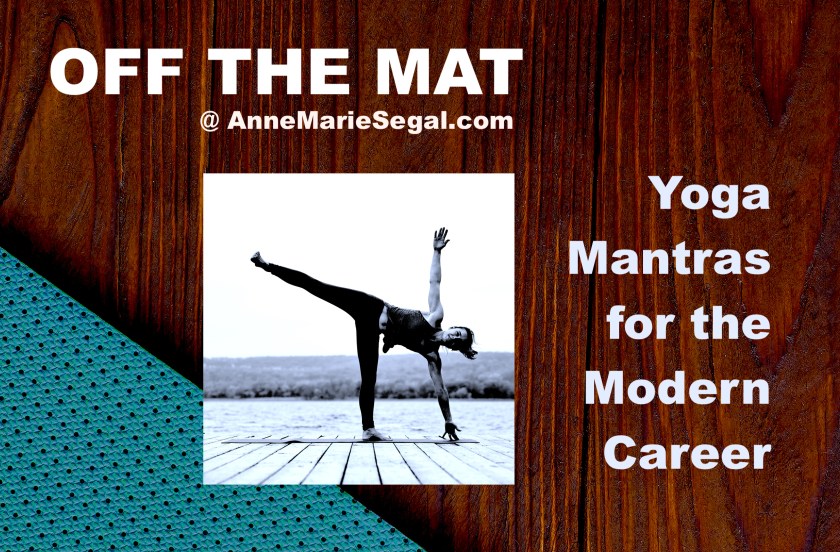
Second image above copyright 2020 Anne Marie Segal. All rights reserved.

Yoga Mantra for January 2020: Set an Intention for the New Year

Welcome to a new decade and my first article in a monthly series, Off the Mat: Yoga Mantras for the Modern Career.

Through this new series, I am creating a space in which I can support clients and readers who are interested in and receptive to furthering their yogic wisdom by providing a means to translate yoga principles to their careers.

This month’s mantra is fitting for the New Year and often incorporated into yoga classes during the first few days of the year (and other times): set an intention.

Yoga Mantras for the Modern Career

Welcome to a new decade and my first article in a short series, Off the Mat: Yoga Mantras for the Modern Career.

WHY I AM WRITING THIS SERIES

When I work with clients, I often incorporate wisdom accessed from my yoga training – I became a certified yoga teacher in 2012 – and ongoing practice.

I am not always explicit about yoga as the source of such wisdom, however, because not everyone finds yoga accessible or personally meaningful to their own lives.

Through this new series, I am creating a space in which I can support clients and readers – among those who are interested in and receptive to furthering their yoga wisdom – by providing a means to translate yoga principles to their careers.

Essentially, in this series I bring yoga to the foreground. Yet these aren’t yoga lessons in the traditional sense. I won’t teach half moon pose, alternate nostril breathing or how to flip your dog. In Yoga Mantras for the Modern Career, we are explicitly taking our yoga off the mat.

How can a (new or existing) yoga practice enlighten your career? How can you integrate what you learn on the mat into your personal or professional life?

This series is my gift to you. In the spirit of yoga, take what serves you and leave the rest.

YOGA MANTRAS

There are traditional yoga mantras straight from the Upanishads, such as Lokah samastah sukinoh bhavantu (translation: may all beings everywhere be happy and free), and more contemporary mantras based on yoga principles.

In Yoga Mantras for the Modern Career, I am building on the idea that every action in our lives can be a meditation and every instruction in a yoga class, however small, can become a mantra.

More specifically, since this site is about leadership, professional development and related areas, the mantras in this series will be in support of your life and career. 

THIS MONTH’S YOGA MANTRA:
SETTING AN INTENTION

This month’s mantra is fitting for the New Year and often incorporated into yoga classes during the first few days of the year (and other times): set an intention.

When we set an intention in yoga practice, we do it in present tense, such as:

I live in the present moment.

The goal is not simply to have your intention on the mat (while practicing yoga) but to take it with you as you move off the mat (into the rest of your life). In the context of your personal and professional life, you might set another intention that serves you:

I have a great career.

I speak fluent Spanish.

I live in New York City.

An intention is stated in present tense, even if it is not your current state. By wording it in the present, you can see yourself as if you have already achieved – and thereby activate the power of – your intention.

Once articulated, your vision is transformed into action through:

  1. continuing to bring your awareness back to the intention,
  2. maintaining a commitment to the intention (for yogis, this is the tapas or fiery discipline of the Niyamas),
  3. holding a confident belief you can achieve it, and
  4. taking active steps to realize your intention.

When clients come to me seeking a career change, promotion or new job, for example, we work (explicitly or implicitly) on some or all aspects of the above.

First, I help them clarify, articulate and prioritize their intention.

On a very granular level, what does it mean to you to have a great career? (This is a version of the classic coaching question, “What does success look like for you?”) 

What is working in your professional life, what needs to change and what specifically would that change look like?

What are the obvious and not so obvious things that would need to shift?

What would you be doing on a day-to-day level (which type of projects, what type of team or individual work, what working environment, how much oversight, etc.)?

The more you can clarify your intention, the more effectively you can keep it on the front burner and take concrete steps to realize it. You may also find that a more specific career or other intention will not only enable a richer and more robust visualization but also increase your ability to keep your awareness on the intention rather than giving way to the inevitable distractions that each moment presents.

Second, we work on increasing their confidence. 

You may have confidence across many aspects of your life, but to achieve your intention you need to have the confidence that you can actually bring it to fruition and maintain that confidence through the process of creating the reality your intention represents.

Third, we devise active, effective steps to realize their intention.

This third aspect works in tandem with the second one, as your confidence will increase as you outline and begin to take active steps to put your intention into action. This may include, for example, moving out of your comfort zone, acquiring new skills or meeting people who can help you realize your goal.

Since the steps to creating a great career may be very specific to your individual case, let’s take a look at the implementation plan for a more universal intention, like foreign language acquisition. If your intention is to be fluent in Spanish, you may decide to take some or all of the following steps:

  • launch a weekly “Spanish table”  lunch group or other gatherings among friends or colleagues,
  • find and listen to Spanish-language podcasts or songs during your morning commute, 
  • engage in community service that exposes you to native Spanish speakers,
  • make a list of and watch top or classic movies or TV shows in Spanish (with or without English subtitles), from an Almodovar classic to Roma or even Jane the Virgin (which is partially in Spanish),
  • hire (or barter English lessons with) a Spanish tutor,
  • get and use magnets and/or flashcards with words and pictures in Spanish,
  • keep a diary in Spanish,
  • read books or magazines in Spanish,
  • do yoga in Spanish (hint: you can get your perro hacia abajo (down dog) going with a plethora of YouTube videos for every range of fitness level and special interest), and/or
  • prepare for and take one or more trips to Spain or Latin America during the year.

The overarching theme is to come at the same intention from a variety of perspectives – in this case, to create an immersion in the Spanish language – which is the same advice I would give for your career or any other aspect of your life.

Remember that part of the wisdom of putting your intention in the present tense is to recognize that you may not need to start from scratch or make a 180-degree turn to realize your goal. If your intention is to have a great career, you may start with recognizing what is already “great” about the current state of your professional life. Do you hold a leadership role? Have a great team? Relish the intellectual challenge? Make a lasting contribution to a cause you support?

If your intention is to be fluent in Spanish, build on what you already do and cherish in your life. So if you are an avid cook, you can start to follow recipes from cookbooks written in Spanish or talk yourself through the steps of your cooking in Spanish and explore any words you are missing. For example, in the phrase “ahora, voy a poner el agua a hervir….” if you don’t know the word for boil (hervir) or always forget that water (agua) uses the article “el” rather than “la,” you can remember both in the context of the sentence.

Although I spend a lot of time above giving examples of steps to illustrate the importance of putting your intention into action, the execution process is not more important than the setting of the intention in the first place. (It simply has more steps, as an intention by its nature is short and sweet.)

You can have the best implementation plan in the world, but if you don’t keep your intention alive and continue to bring your awareness back to it, outlining the steps will get you nowhere. We will meet here again month after month, New Year after New Year, and you will ask me why you have not (sufficiently) progressed. I am certain that is not what you seek!

Instead, post your intention at the top of your mat or on your bathroom mirror – literally, with a sticker or sticky note – and return to it every day.

MY OWN INTENTION FOR 2020

My own intention for the New Year is the first one written above:

I live in the present moment.

Carter at the Beach for New Year's

At Compo Beach for New Year's

Yesterday, on January 1, I took my dog (Carter) to Compo Beach for the first time. It was windy and cold but lovely nonetheless. Carter was ecstatic, and I had lot of fun keeping pace as he raced and frolicked across the beach.

Today is a new day and another chance to reset or refine my intention. 

Happy New Year! What’s your intention?


Anne Marie Segal 
is an executive coach, resume writer and author of two well-received books on interviewing and career development. She served as a corporate attorney for 15 years, including roles at White & Case LLP and a prominent hedge and private equity fund manager, before launching her coaching practice. In addition to her career coach and resume writer certifications, she is a certified yoga teacher. 

Based in Connecticut not far from New York City, Anne Marie partners with clients internationally on executive presence, impactful communications, graceful transitions and other aspects of professional and personal development. 

Second and third images above copyright 2020 Anne Marie Segal. All rights reserved.

Befriend Your Inner Naysayer: It May Be Trying to Tell You Something Worthwhile

SELF-SABOTAGE can happen at any the time. We try to create something important to us, whether it’s greater leadership or a deeper sense of calm, and we get in our own way. The internal naysayer takes the lead, and we convince ourselves that it’s easier to stick with what we have.

Except that it’s not easier. You feel the call to change because there’s a fundamental imbalance in your life. Something that’s not working anymore.

So how can you change the way you talk to yourself?

Young beautiful woman standing over yellow isolated background hand on mouth telling secret rumor, whispering malicious talk conversation

SELF-SABOTAGE.

It can happen at any the time. To any of us.

We try to change our lives or create something important to us, whether it’s greater leadership or a deeper sense of calm.

And boom. We talk ourselves out of it.

It’s too….

  • Hard
  • Expensive
  • Long
  • Boring
  • Intense
  • Unrealistic
  • Unwanted
  • Different

Whatever the reason(s), we get in our own way. The internal naysayer takes the lead, and we convince ourselves that it’s easier to stick with what we have.

Except that it’s not easier. You feel the call to change because there’s a fundamental imbalance in your life. Something that’s not working anymore. A job, a relationship or even a deeply held belief that needs to change.

After all, if it were truly easier, you wouldn’t be called to change. You wouldn’t have the nagging feeling that keeps you up at night or the emotional turmoil that haunts you during the day. You would have a sense of purpose. A sense of calm.

Even if the change is not within your power, and you are adjusting to a change that you didn’t want, there will be an emotional gap – and possibly other gaps – between clinging to the past and embracing the change. This gap will take a toll that is ultimately harder to  bear than taking the necessary steps to adjust to and actively redirect your life or situation.

Would you like an example?

Say you were laid off from a job. Your instinct could be to close off from the world, lick your wounds, protect yourself and mourn the loss. Yet what you likely need most, after a few days to regroup, is to get out and find another opportunity.

Your internal naysayer (a.k.a. worry brain) says:

“You should have seen this coming.”

“You don’t have the time for this.”

“Why did you have to screw this up?”

“You are getting older. No one is going to want to hire you.”

Or any of many other negative messages that people feed themselves.

The crux of the problem is this: your naysayer can’t simply be silenced. It needs to be heard, because it’s telling you something important. It houses the deep-seated fears that developed over the course of a lifetime. 

While your naysayer can’t be silenced, it can be befriended and turned into an ally. To do that, you need to make a mindset change before the intended change.

Are you ready?

First, take a deep breath. Inhale and exhale. Maybe a few breaths….

Then venture into the forest of your fears. Visit as an invited guest. Stay a while and see what lies there and what you can learn.

Beautiful, foggy, autumn, mysterious forest with pathway forward. Footpath among high trees with yellow leaves.

If your worry brain is whispering (or yelling) at you, take time to explore it.

A message like “this is all your fault” or “this change is beyond your grasp” has a deeper meaning behind it, and if you can grasp the meaning, you can find value in the fear.

This is all your fault.

Rarely is anything ALL your fault. But assume for a moment that your naysayer brain is squarely assessing you with a great deal of blame.

Remember, the naysayer can’t be silenced. Nor should it. It’s there to warn you of danger, and you can trust its intuition. The problem is, while the naysayer is good at identifying possible danger, it is not as good at quantifying it. That’s the job of another part of you: your ability to problem-solve and reason, which you can only do if you are not emotionally charged.

So try an experiment. Befriend the naysayer and thank it for its insight. Then tell it:

“Rather than focusing on blame, let’s see what we can learn from this situation. There are certainly ways I can develop greater foresight and resilience.”

Or simply:

“Thanks for the warning. I’m good.”

The naysayer (worry brain) part of yourself can then calm down, because you have changed the way you talk to yourself.

This change is beyond your grasp.

If your internal naysayer is raising a stink that a change is too much for you, take a walk into the forest of your fears. What can you learn?

  • Is it a good change for you?
  • Are there hidden consequences you should explore?
  • Is there an easier way to get where you want to go?
  • Could you break a larger change into stages?
  • Are important people in your life going to be disturbed by this change?
  • Do you have mixed emotions yourself that are worth exploring?

Explore these questions and any others that arise. Write down what occurs to you as you meditate on the change. You can use either stream-of-consciousness writing or a tighter, more structured exploration on a whiteboard or the equivalent. Whatever you do, get it down on the page so you can sort, quantify and evaluate what you are thinking and feeling about the change.

Engaging in this mindset work to acknowledge – rather than try to supersede or hide – your fears will strengthen your resolve and give you greater ease in the change management process. Befriending your inner naysayer will help you create a fruitful internal dialogue about your goals, appropriate risks and the best way to navigate both the changes you elect to make and the ones that appear in your life.

Feel free to make a comment, post a question or “like” this post below. Thanks!

Anne Marie Segal Post Banner

Anne Marie Segal is an executive coach, resume writer and author of two well-received books on interviewing and career development. She served as a corporate attorney for 15 years, including roles at White & Case LLP and a prominent hedge and private equity fund manager, before launching her coaching practice. Based in Connecticut not far from New York City, Anne Marie partners with clients internationally on executive presence, impactful communications, graceful transitions and other aspects of professional and personal development. 


Coming in early 2020:

The 28-Day Career Mindset Journey at Segal Online 24/7

You may also like:

Old Dog, New Tricks: What Can You Change Before Year End?

The Ultimate Holiday Dilemma: Donut v. Orange (Or, Practical Strategies for Better Decisionmaking)

For a list of articles by topic on AnneMarieSegal.com, click here.

Old Dog, New Tricks: What Can You Change Before Year End?

Happy businesswoman jumps in the airport

Most of us, thankfully, do not need to learn a new form of martial arts to effectuate the change we want to see in our lives. It could always help, yes, but it’s not the natural next step.

Yet we do have something eluding us. A piece of the puzzle we have not yet fit, and we cannot reach the next goal (even one we have been desperately seeking) without finding and placing that piece.

But human beings are stubborn. I know I am. And yes, I’ll say it, some of my clients are stubborn too.

Too often, we know what will serve us – what we need to do, so we can do what we want to do – but we make excuses. We are like old dogs who refuse to learn new tricks.

AdobeStock_217290201 (old dog).jpg

So here’s what you do to change that:

(1) Take some time to chill. (Relax, settle in and create some emotional space.)

(2) Review what you wish to bring into your life, and articulate your top goal between now and year end. If your goal may not (or cannot) be completed by year end, choose a manageable goal that is a piece of a larger goal, and repeat these steps in the New Year. For example, rather than “get a new job,” your goal may be to take certain concrete steps toward that end. Focus on what you can change, without attachment to outcomes.

(3) Embrace the vulnerability that you need to move out of your comfort zone. Be prepared to fail, but also be prepared to succeed. In fact, redefine success as a series of steps, not only as an end point.

(4) Embrace the power that you can call forth, from the depths of your being, to reach your goal.

(5) Envision all of the ways you (yes, you) and your family, friends, team, community and/or others. will be better off when you have reached your goal.

(6) Build a support network for your change, even if it’s only one person. Ask them to hold you accountable at each step.

(7) Be curious about what you need to reach your goal, and take the time to explore the most efficient path for you to get there. 

(8) Focus on the present. Not what you could have done last summer, last year or five years ago. What can you do now to achieve your goal? Keeping yourself in the present keeps your emotional energy available for solutions rather than stressing.

(9) Create a realistic action plan and work your plan. Reverse engineer your possible investments and divisions of time and energy to prioritize this goal among other obligations.

(10) Be your own best fan. Cheer yourself on, and celebrate your wins in a way that is meaningful to you.

AdobeStock_248045295 (joy).jpg

Focus on what you can change, without attachment to outcomes.

In the career context, your goal may be to build something, such as:

  • Resilience
  • A Calmer Demeanor
  • Relevant Skills or Expertise
  • A Stronger Professional Network
  • Gravitas and/or Greater Recognition in Your Field

Choose the goal that’s most pressing for you, and stop giving yourself excuses! Feel free to drop me a line telling me what you have been able to achieve.

Anne Marie Segal is an executive coach, resume writer and author of two well-received books on interviewing and career development. She served as a corporate attorney for 15 years, including roles at White & Case LLP and a prominent hedge and private equity fund manager, before launching her coaching practice. Based in Connecticut not far from New York City, Anne Marie partners with clients internationally on executive presence, impactful communications, graceful transitions and other aspects of professional and personal development. She also offers online instruction at www.segal247.com.

Image credits: Adobe Stock.

The Ultimate Holiday Dilemma: Donut v. Orange (Or, Practical Strategies for Better Decisionmaking)

Today is December 1. We are on the cusp of another holiday season and faced with the age-old dilemma:

How can we make good decisions in a world of tempting choices? 

Donut v. Orange image.png

Whether it’s a diet, career or other choice in the coming days or months, how do we ready ourselves to take the better path… the longer view?

In this short video, I share some key strategies to making better decisions in the face of life’s pressing questions, such as:

How do I choose the orange when I really want the donut?


Follow-up comments or questions welcome. Happy holidays!

Anne Marie Segal is an executive coach, resume writer and author of two well-received books on interviewing and career development. She served as a corporate attorney for 15 years, including roles at White & Case LLP and a prominent hedge and private equity fund manager, before launching her coaching practice. Based in Connecticut not far from New York City, Anne Marie partners with clients internationally on executive presence, impactful communications, graceful transitions and other aspects of professional and personal development. She also offers online instruction at www.segal247.com.

Why We Love (and Lament) Thanksgiving

Thanksgiving, as it is practiced in the countries that celebrate it, is a nationwide day of gratitude. We are called to stop our busy lives and reflect on what really matters to us most. Extra credit is granted if we actually spend time with the people who matter to us, doing the things that matter to us and living in the present moment.

Something inevitably gets in the way. A relative makes a misplaced comment. A loved one would rather watch the football game than engage in heartfelt conversation. (Or, conversely, a loved one would rather talk than turn on the TV.) The food isn’t ready on time. We eat too much and feel like we are going to burst. The dog steals the pie right off the table. A work issue draws us away from the celebration.

Or occasionally, a true, pressing emergency arises.

Each of these distractions, disappointments and interruptions can take us away from the present moment by highlighting a gap between how we imagine Thanksgiving and the reality of what we are experiencing. I know that has happened to me. For many years, I had an idealized version of the holiday, and I worked very hard to meet it.

Distractions, disappointments and interruptions can reveal the gap between our idealized and real experiences.

This year, I stopped working so hard. In fact, I put aside the “work” mindset altogether. I took each moment as it came, each interruption as an opportunity to experiment and each person as they arrived that day.

The dog ate all the pie…? Now what?

If you will laugh about it next year, laugh about it now.

It would be superficial and misleading to say that this mental shift was achieved in one day. I have spent most of 2019 – and indeed, good parts of prior years – peeling back the layers of why I feel the need to work so hard. If I were to universalize the main discovery, it is this:

To simply be present with who and where we are, we need first to be content with who and where we are.

We love (and lament) Thanksgiving because it brings us face to face with this truth. It is the same with every holiday, celebration or tradition that purports to stop time. If we are stuck in cognitive and emotional dissonance – knowing and feeling to our core that our outward life conflicts with what we want and know to be true for our lives – we will not be able to live in the moment. We will constantly be trying to fix things, but they will be the wrong things, because we have not yet closed the gap between our ideal and reality.

Serenity and yoga practicing,meditation at mountain range

When we are not content with our reality, we set up a dichotomy. We imagine that somewhere far away, we could experience a reality that would truly allow us to experience the present moment. Yet the only way to bring that far away place and truth into our current reality is to first be content with where we are today.

Otherwise, we can climb every mountaintop but find no inner peace. We can transverse the globe or drive across three states to visit relatives, friends or sacred spaces yet return tired and spent rather than refreshed. We can do lots of “work” to create an idealized holiday, while we would be better served by embracing the day. We can continue to leave no stone unturned, on a restless quest, ignoring the rich stones in our own gardens.

As we move through the final days of November, turn the page for December and start the New Year, let’s look ahead but also stay present in NOW. Whether it is Thanksgiving weekend for you now, or a regular weekday now, how can you allow your reality to be closer to your vision? What large or small steps can you take to grant yourself freedom, forgiveness, expansive breath and emotional space?

What large or small steps can you take to grant yourself freedom, forgiveness, expansive breath and emotional space?

In my coaching practice, when clients wish to change jobs, we often start with what they can change in their current situation. Sometimes it is an outward change, such as asking for more responsibility in a competency that is highly relevant for their careers and in which they wish to grow. Sometimes it is an inward change, such as creating better boundaries or growing their influence across (and outside of) the organization. We also ask what is working, so they do not lose sight of what they already have.

Taking it back to the holiday season, what feels like an unsurmountable gap between your ideal and reality? How can you close that gap? How can you reflect on the lessons of yesterday and today to create a present moment that serves you?

Feel free to leave a question or comment below.

Anne Marie Segal is an executive coach, business and resume writer and author of two well-received books on interviewing and career development. She served as a corporate attorney for 15 years before launching her coaching practice, including roles at White & Case LLP and a hedge and private equity fund manager. Anne Marie is based in Stamford, CT and serves an international clientele. 

Image above: Adobe Images.


Optimizing Your Transition Into a New Role: The 30/60/90-Day Plan

As you start a new job or take on a significant promotion, implementing a 30/60/90-day transition plan will help organize and optimize your first 90 days in the role.

You have likely spent weeks, months or even years seeking out and securing the next step in your career. Once settled, it might be tempting to celebrate, give notice to your current employer, hunker down (or enjoy a brief vacation) and then jump right into the mix. But what if you could create a more deliberate entry point for greater success and to ease your transition?

Through my work as an executive coach, I have witnessed time and again that the final step in a successful job transition is not accepting the offer. Candidates who make the greatest and most lasting impact consistently prepare themselves ahead of time for those critical first few months in their new role.

Herein lies the genius of a well-devised plan.

Recognizing Why You Need A Plan

When I work with coaching clients to develop 30/60/90-day plans, I invariably start by sharing this article by David Gee, which he wrote about his first 90 days as the chief investment officer of Credit Union Australia Limited.

As Gee attested, and as many of us have experienced over our own careers, either we set an agenda and priorities for a new role or our days are quickly overrun by the sheer volume of activity. Gee wrote, “I learnt very quickly that events and meetings would consume me unless I was clear where I wanted to focus my time and energy.”

While you may enter a role with the expectation of a fresh start and ample ramp-up time, work often takes on a life of its own as early as the first day or week on the job. Communicating an actionable 30/60/90-day plan to your team goes a long way in ensuring you are doing the right things among the busyness of business.

Structuring Your Plan

If you are not familiar with 30/60/90-day transition plans, Gee’s article offers an excellent overview. He structured his plan as a chart with “People,” “Process” and “Technology” as headers. Within each, he defined high-level departure points to guide his execution of top priorities, such as:

What does success look like?

What are the CEO’s expectations?

Who are the key players (outlined in a stakeholder analysis and influence map)?

Gee’s chart features both a high-level structure and sufficient detail to keep him on track. As you review it, reflect on the relevant questions and guiding principles for your own plan and how to best structure what you want and need to make your greatest sustainable impact in the first 90 days.

Individualizing Your Plan

One of my C-level clients, let’s call her Jordan, structured her own 30/60/90-day plan as follows:

In successive rows of her header column, Jordan listed her main constituents (board of directors, CEO, other C-suite leaders, regional managers and her team) followed by top anticipated projects and other areas to address. In the remaining columns across her chart, she mapped her goals for each over 30, 60 and 90 days.

While Jordan would have valued time to settle into her role before leaping into action, she was hired by her new CEO on the assumption she would swiftly shore up certain trouble spots in the organization (and be compensated accordingly).

On her plate was to help realign a splintered board of directors, merge diverse geographical regions under a smaller subset of managers and replace two key employees (which she labeled as Projects A, B and C), all while meeting the overarching goals of increasing revenue and raising the organization’s reputation in the marketplace.

People – Impact

30 Days 60 Days 90 Days
Board of Directors
CEO
Team
Project A
Project B
Project C

By breaking up each of Projects A, B and C into achievable goals over manageable periods, Jordan could better predict the steps, time investment and travel schedule she would need to tackle each one. She also could clearly map out how her efforts across these projects would support larger organizational goals.

Tempted to triage and move to execute on each of these projects as soon as possible, Jordan nonetheless recognized that she first needed to set the tone and goals for her own team. She devoted the mornings of her first week at her new office to meeting with team members individually and spent afternoons on conference calls discussing each project in turn. In this way, she gained clarity, demonstrated authority and made initial progress on all key areas, as well as with her team.

Jordan then devised a tight yet manageable travel schedule for the following three weeks. She planned flights to five cities over two trips—making creative use of layovers—with a short break in-between. This put her face to face with individuals (scattered across the country) who were critical to her understanding of long-standing issues and generation of practical, optimal solutions.

AdobeStock_92595365 (priorities).jpg

Setting and Achieving Your Priorities

As you reflect on Gee’s and Jordan’s plans and devise your own, you may wish to include some agenda items from Gee’s chart:

  • Building relationships, coalitions and your team.
  • Branding yourself.
  • Setting the time to reflect.
  • Establishing and monitoring key personal metrics.
  • Ensuring accountability.
  • Executing quick wins that can foreshadow more substantial improvements.

Gee took pains to meet as many people in the organization as possible in his early days in the role. Speaking from a position of leadership, he also told his team what he stood for, how he liked to work and what he expected from them. Finally, he made sure that his progress, as measured against his 30/60/90-day plan and more generally, was “very visible” to his manager and team.

While a 30/60/90-day plan cannot guarantee success in a new role, outlining high-level goals and priorities with an accompanying action plan will facilitate the right mindset and allow for more seamless execution. Seek feedback from others as appropriate – either prior to your new role or in the first days at the office – and make sure to consider and include enterprise, team and individual goals.

Anne Marie Segal is an executive coach, resume writer and author of two well-received books on interviewing and career development. She served as a corporate attorney for 15 years before launching her coaching practice. The above article, other than the chart (added here), was originally published as a Forbes Coaches Council post and available here.

Image above: Adobe Stock.