Nine LinkedIn Strategies: Which One Matches Your Goals?

LinkedIn® is a lightening rod, charging up diverse opinions about the best way to approach it. At one end of the spectrum, you hear that being on LinkedIn is a waste of time or, worse yet, only for those who wish to commoditize themselves. For many others, LinkedIn is the best thing to happen to online networking, a free space to invite the world to hire you, connect with you, buy from you, etc.

I suggest you start with the end in mind: what do you want LinkedIn to do for you? Once you know your target, you can devise the best strategy to get there.

shutterstock_424534183 darts on target.jpg
Eyes (and darts) on the target. Shutterstock image.

LinkedIn® is a lightening rod, charging up diverse opinions about the best way to approach it. At one end of the spectrum, you hear that being on LinkedIn is a waste of time or, worse yet, only for those who wish to commoditize themselves. For many others, LinkedIn is the best thing to happen to online networking, a free space to invite the world to hire you, connect with you, buy from you, etc.

I will not say that the truth lies somewhere in between, as I don’t think LinkedIn (like anything else) lends itself well to one-size-fits-all. Rather, when I teach groups or individuals about LinkedIn, I suggest you start with the end in mind: what do you want LinkedIn to do for you? Once you know your target, you can devise the best strategy to get there.

Here are nine basic LinkedIn strategies. Which one works best for you?

1) No Profile. The No Profile approach is favored by a range of individuals, from those who wish to signal they are too elite for LinkedIn to those who conduct business exclusively offline, whether by choice or association. If your professional strategy is to maintain a low online profile and let your reputation and in-person dealings speak for themselves, then LinkedIn may fail the cost-benefit analysis. If this strategy appeals well to your target audience (be it family offices or firemen) and doesn’t lead to a number of missed opportunities, then it is probably the best choice for you.

2) Stealth. Those who have a Stealth profile want to be able to search for others without revealing anything (or very little) about themselves. They are similar to the No Profilers, except that they want access to LinkedIn’s goods without making an offer in return. Like the No Profilers, the Stealth strategy is helpful if you believe that you have nothing to gain, and only something to lose, by putting your talents “out there” into the marketplace so that someone may discover you. Note that the Stealth Profile is often similar to the Just Getting Started Profile, which is not a strategy at all, just someone who has not bothered to understand or master LinkedIn. (Also note: beware Stealth connectors, who may be looking to hack into your network.)

3) Minimalist. A Minimalist profile, if done intentionally, also conveys that someone has “better things to do with their time” than be on LinkedIn. In some cases, this strategy is effective. However, like the profiles above, it probably will not generate interest (or new opportunities) among LinkedIn’s reported 100 million users. That said, having a Minimalist profile does allow you the benefits of building a network among your close connections. It also may be useful to have a minimal presence if your company actively restricts what you can post or obviously frowns on LinkedIn, as it does allow people to search specifically for your profile and find you (if they know what they are looking for). For those in finance or information technology, for example, a Minimalist approach is sometimes the only way to enjoy some of the benefits of the LinkedIn service without risking account or policy breaches.

4) Basic Professional. The straight-shooting Basic Professional LinkedIn profile includes a bit more information than the Minimalist profile, such as a professional picture, descriptions for some or all jobs, and possibly a summary. It may also include some keywords (i.e., important nouns that can match up to online searches by hiring managers and recruiters), and it has enough information to actually allow the reader/viewer to understand who you are and what you do professionally. It often does not give personal details (that could create a connection), and generally there is little or no creativity in the text or enhancement beyond completing the basic profile fields. Often, it is written in the third person.

The Basic Professional profile is most effective if your strategy is to use LinkedIn for “verification” purposes – giving the reader/viewer comfort that your profile matches the information they already have about you – rather than to generate leads through LinkedIn. It will not be sufficient to propel you to the top of LinkedIn search results (when someone is searching for an individual with your background and talents), so if that is your end game, you should consider a more robust strategy. That said, for certain individuals who want to maintain some distance with the public, as a matter of personal branding or due to the nature of their work, a Basic Professional profile may strike the right balance.

5) Inviting. The strategically Inviting profile can be a variation of the Basic Professional, or it may be more creative and “loose” in its presentation. Inviting profiles often incorporate keywords but are also geared toward making a connection. To that end, an Inviting profile, which is often written in first person, is written with a “human voice” to be appealing and develop a bond or kinship with the viewer/reader. Most job seekers and entrepreneurs benefit from Inviting profiles, especially if they are Active (see below), and thought leaders use them to their advantage as well.

Inviting profiles are in some ways what LinkedIn is all about. They say more than a résumé format ever could, and they encourage people to connect with you because they highlight your talents, accomplishments, interests and goals as an individual. In addition, they can facilitate an interview or other professional conversation (whether for networking, business-generation or employment), because you have already made a good first impression and answered some of the basic questions, including your value proposition, with your Inviting profile.

6) Highly Creative. A Highly Creative profile is similar to an Inviting profile, although rather than putting down a welcome mat for all, it goes all purple shag carpet to say, “Look, I’m different. I am on LinkedIn, but my way.” This strategy works best if you are the one to call when someone is looking for the proverbial needle in a haystack (rewritten, of course, without the cliché.) Like the earlier profiles on this list, the Highly Creative profile generally works best when your reputation precedes you, although the link can be included in marketing materials and”worked” that way, and keywords can be gently massaged into the message to increase the likelihood your profile is found by the right audience. Needless to say, this profile works best for those who are solidly ensconced in a creative field, where innovation is prized. It does not go over so well in banking.

7) Active. I include Active as a separate profile strategy, although it often piggybacks on one of the strategies above. An Active LinkedIn profile is one that includes all of the basic elements of LinkedIn (picture, summary, recommendations, keywords, skills, etc.), which are points that LinkedIn’s algorithm uses to “score” how high up you appear in any given search results. In addition, LinkedIn rewards its users (again, as far as search visibility) for being active within LinkedIn, such as participating in groups, sharing, posting and interacting with others’ posts.

A note about Active profiles: It is often hard to start up an Active profile without triggering a concern that you may suddenly be in the midst of a job search. Being at least minimally active on LinkedIn before you need it is part of the Active strategy.

8) Transition. A very light touch is needed for a Transition profile. The trick is to continue to appeal to one’s current audience without tipping your hand about a possible change, while adding enough keywords and information to your profile to hook and appear credible to your new audience as well.

A subset of the Transition profile is an analogous strategy that is often overlooked. Another goal of a Transition profile may be to use LinkedIn not to find a job at a new company but to highlight your talents within your current company – i.e., get promoted or make a lateral move – so that CEOs and others with whom you are connected can see not only what you offer to your current position but also what you will bring to the company in the new role. In many ways, LinkedIn is the perfect platform to reinforce your goal to have your talents recognized, because it is unlikely (unless asked) that you will be sticking your résumé under the nose of senior management. To be effective in this strategy, you need to highlight aptitude rather than simply focusing on what you have done.

9) Straddler. Like Career Changers, Straddlers target more than one audience, but a Straddler has one role he/she wishes to keep and another one to add. For example, a lawyer may also be a budding fiction writer or aspiring corporate board member, wishing to highlight both sets of talents and appeal to both networks. Rather than creating entirely separate profiles – which can be time-consuming and confusing – a Straddle profile is created by weighing the relative merits and costs of each element added to maximize the benefits of a combined profile while minimizing the risks that any key target audience might not find this approach appealing or effective. A Straddler must very carefully evaluate whether the “second part” of a profile enhances the Straddlers credibility for his/her main target roles or detracts from it. Each audience will respond to different aspects of your profile, and the trick is to highlight the relevant parts without appearing disjointed. 

Unless you want to approach LinkedIn haphazardly, each of the above types of profiles represents a choice of how you wish to present yourself and what return you are seeking from LinkedIn. Whatever strategy you choose from the above, it behooves you to approach LinkedIn with your goal in your sights rather than simply writing about yourself and posting it to the world. As with anything in life, if you know your target, you are more likely to hit your target.

Originally published on LinkedIn Pulse at: https://www.linkedin.com/pulse/nine-linkedin-strategies-which-suits-you-best-segal-jd-ccmc-cprw

Young Women & Interpersonal Cues: Missing Them Can Undermine Your Career Advancement

By bowing out, she had taken a backseat, undermining herself. Julie had made a decision, perhaps unconsciously, that she was not an important member of our makeshift meeting. As a result of her stepping away at a critical point in the conversation, Julie gave away her power.

At my office recently, I was approached by someone in the hallway I had never met, a fellow tenant (let’s call him George) with a business complimentary to mine. In a few minutes, it became clear George wanted to sell me on something, an idea more than a product or service. He talked excitedly in a loud voice, as he got himself pumped up on a concept that was close to his heart – a local monthly networking group he leads that he wanted me to join. I mentioned that I knew someone from George’s office, a young woman who worked for him (let’s call her Julie), whom George called out to join us. Julie popped out into the hallway a minute later to say hello, as we continued our conversation.

Suddenly, the floor receptionist (let’s call her Clara) appeared. Clara beckoned Julie to come over and answer a question, oblivious to the fact that three people standing in the hallway deep in conversation could be a “meeting” that was just as momentous as a sit-down affair. It did not appear that Clara wanted to talk about anything important, just a routine matter, and I expected Julie to wave her off with a promise to catch up shortly.

And then a very odd thing happened. Something that I had almost forgotten young women can get wrong and how damaging it can be to their careers.

What happened is this: Julie left the conversation. Like the receptionist Clara, who had no skin in the game, Julie missed the cues. She did not grasp that this spontaneous 15-minute meeting in the hallway was important to George, that it’s the way he does business. George was very obviously giving me his elevator pitch, growing his base of support and relying on Julie to help him carry it to a close. And Julie missed the ball. Completely.

The fact was not lost on George, as he made very clear a moment later. “Julie, where are you going?” he asked, as Julie and Clara stood in the hallway, five feet from us, whispering back and forth in their own private conversation. I expected again for Julie to wave Clara off, reading the cues from George, or at least to try to do so, but again she did not.

shutterstock_195039251

“Clara has a question for me,” Julie said flatly, turning her back on us and continuing the conversation. She did not excuse herself by mentioning anything about the relative importance of Clara’s question, that there was an emergency, that she would be “just 30 seconds” or anything to mitigate her allowing a seemingly unnecessary break in the flow of conversation. George continued to speak with me, although he was visibly annoyed by Julie’s absence, turning to glance at her out of the corner of his eye until she finally returned.

As the observer of this interchange, I wished I could communicate to Julie what I had witnessed from a third-party perspective. By bowing out, she had taken a backseat, undermining herself. Julie had made a decision, perhaps unconsciously, that she was not an important member of our makeshift meeting. She was not part of the sales conversation, she “happened” to be there, and could just as easily have been somewhere else without affecting the outcome. This is an error, in fact, because Julie was the link between George and me, as I had only just met George in the hallway and had known Julie for months. If I were to be persuaded to “buy” what George was offering, she certainly could have tipped the balance.

As a result of her stepping away at a critical point in the conversation, Julie gave away her power, allowing herself to deal with minor administrative tasks while a potentially profitable referral relationship was being made (or lost). Or, if there indeed was a pressing need to speak with Clara at that moment, Julie had not communicated that fact in a clear manner so that George (1) felt confident to rely on Julie’s judgment call to leave the meeting, and (2) had maintained focus on his train of thought and momentum, rather than being distracted from his intent. Julie’s actions subtly communicated the opposite: that she felt George did not need her. The key problem is that if George hears this message too many times at critical points in Julie’s career – he doesn’t need her – then, in fact, he won’t.

Have you witnessed a situation like the one I describe with Julie? As women, we want to be recognized as powerful, strong partners in the business world. There are unseen obstacles to our success, and we are denied opportunities based on our gender. And sometimes, we give the power away ourselves. We need to read, and give, helpful interpersonal cues. When we value our own worth and prioritize the more meaningful contributions we can make, we increase our engagement and opportunities in our careers. 

Originally published on LinkedIn Pulse as “How Young Women Can Undermine Themselves in the Business World by Missing Interpersonal Cues.”


Key Moments to Raise Your Hand (And Volunteer for New Projects During Your Career)

In the corporate world, and in other work environments, there are key moments at which you should raise your hand and volunteer for a new project or responsibility. Once you “own” a project that is going nowhere, it can be difficult or impossible to beg off at a later point. Knowing which moments are the right ones to volunteer is essentially a process of considering the end game. What are you hoping to get from the experience, and what value will it bring?

shutterstock_126949148 (hand raised).jpg

When to say “I’ll do it!” and when to let an opportunity pass you by.

In the corporate world, and in other work environments, there are key moments at which you should raise your hand and volunteer for a new project or responsibility. These moments are critical to get right, because once you “own” a project that is going nowhere, it can be difficult or impossible to beg off at a later point. Knowing which moments are the right ones to volunteer is essentially a process of considering the end game: what are you hoping to get from the experience, and what value will it bring?

If you were always someone who raised your hand in school, eager to step up to the plate, you may volunteer too often and get stuck managing or completing projects that have minimal value to you and the organization. If you prefer instead to keep your head down and “get your work done,” you may miss some critical points to increase your leadership, reach and range. Striking a balance between appearing desperate to get noticed for doing a great job and disinterested in new work, here are three key factors to determine whether you should raise your hand when the boss is asking for volunteers.

  1. Is it high profile?
  2. Is it high need?
  3. Are you highly motivated to do it?

In general, if you have at least two out of the three hits above, you should probably be ready to go for it.

HIGH NEED / HIGH PROFILE

All things being equal, high need/high profile projects are, of course, the best projects to be on. You can increase your political capital within the organization by solving something mission-critical, and you can increase your visibility and level of responsibility for years to come.

If you are highly motivated to complete a high need/high profile project, you have the best of all worlds. On the other hand, if you do not initially feel motivated, brainstorm for possible motivators to get you going, including the obvious points I mention above. Generally, if you are in the right field and concerned about your career, you can generate the motivation to complete projects that meet the other two criteria by focusing on the initial and long-term results they will will bring to you and your company, whether or not the day-to-day tasks are always inspiring.

(Note: If you cannot muster up motivation despite the benefits, you may wish to keep your hand down and re-evaluate your commitment to your chosen role.)

HIGH PROFILE / LOW NEED

High profile projects can bring many benefits, but if they are not important to the organization, consider your motivation before volunteering. You may appear inauthentic, harming your credibility, and in the long run you may not have the commitment to do a good job (while on stage in front of the important individuals and teams within your organization). Examples of high profile/low need projects are the pet projects of senior management, which may allow you to rub elbows with the “right folks” but do not significantly advance (or redeem) the main profit drivers of your organization.

HIGH NEED / LOW PROFILE

Similar to high profile/low need projects, you may only wish to volunteer for high need/low profile projects when you are and can remain highly committed to them until completed. In addition, you should weigh the number of these types of projects that it makes sense to take on at one time.

If you do have strong (or sufficient) motivation to manage or participate in these projects, they could be a boon for your career, teaching you new substantive skills and helping you develop further leadership and self-reliance. You also will demonstrate your commitment to advance the goals of the company, even when being “in the trenches” does not yield an immediate gold star. That commitment can bridge the gap to yet another project that is more significant, if the earlier ones go well for you, and also give you a sense of accomplishment and meaning in your career.

LOW NEED / LOW PROFILE

In the case of a low need/low profile project, you likely should not volunteer regardless of how motivated you are to become engaged in something, unless your goals are no longer aligned with your company and current career path. These projects offer little in terms of advancing your career within a company, and in fact will present an opportunity cost, taking you away from more significant work. If you are tasked with one of these projects without volunteering for it, you may wish to accept it graciously and do your best to complete it (or, if appropriate, discuss your views on why it is not needed). If you are tasked with many of these projects and at the same time wondering why you cannot get traction in your career, you may wish to revisit your career goals and standing within the organization.

Copyright 2016 Anne Marie Segal. All rights reserved.

Attorneys: Your LinkedIn Headline in 120 Characters or Less

You have 120 characters in your LinkedIn headline. (No, not 140. That’s Twitter.)

120 characters to sell yourself to the world. Yes, I said sell. LinkedIn is not where you find enlightenment. It is where you find clients, contacts or a job. If you are not already, you need to be crystal clear on the distinction, whether or not you like it.

Important Update in 2017: Following Microsoft’s acquisition and restructuring of LinkedIn, many of the features have changed. For example, only a portion of your headline and the first few words of your summary are visible in many cases until someone clicks to see more. This makes is critical to have the essential information that reflects your value proposition – or otherwise draws people in – right at the top. You can check this out for yourself by accessing your own profile through various devices.

So what should it say?

Should you opt for something short, try to get in as much as possible or meet somewhere in the middle? How “out there” should you be with your job search?

I hear these questions from clients every week, if not every day. One of the main goals as a résumé writer is to help my clients see how they appear to a third party, especially a potential recruiter, hiring manager/partner, interviewer or other job search facilitator. We are often so wrapped up in our own stories that we forget how we appear to the outside world.

Take a look at a range of possible headlines below, which could easily describe the same individual at various points in his/her career. Depending on how he/she wanted to be perceived, some of these headlines are clearly more effective than others.

Can you immediately tell which ones?

– Scroll down for commentary –

Capital Markets Attorney, Counsel | Derivatives | Global Funds | Dodd Frank & EMIR

ISDA/Derivatives Attorney

ISDA Attorney | Derivatives Counsel

ISDA Attorney | Derivatives Counsel | Hedge Funds

ISDA Attorney and Derivatives Counsel at [Name of Employer]

ISDA Attorney at *

ISDA Attorny [sic]

Contract Attorney

ISDA Attorney Seeking New Opportunity

Attorney Seeking a New Opportunity

Versatile & Business Savvy Senior Attorney with 20+ Years of Effectively Resolving Complex Issues and Managing Risk

Senior Business Savvy Attorney

Experienced lawyer seeking engaging legal employment

Attorney, actively seeking employment

VP, Legal

Vice President and Associate General Counsel

Associate General Counsel

Financial Transactions Attorney

Corporate Finance Professional and Attorney | Investment and Corporate Banking

Attorney | Advocate

Attorney

Financial Services and Trading Counsel

ISDA Counsel and Negotiator

Experienced Derivatives Attorney and Published Novelist

Attorney/Writer/Humorist

Clearing, Dodd-Frank & ISDA Attorney

Fixed Income and Derivatives Attorney, Contracts Negotiator

ISDA, Prime Brokerage, Securities Lending, Repurchase, and Futures Negotiator

Derivatives Attorney

ISDA/Futures/Derivatives Attorney

Financial Transactions Attorney

Senior Derivatives/Regulatory/Capital Markets Attorney

– Commentary –

Clearly there is much more to say than I can cover in a short blog post, but here are some general thoughts to guide you:

First, consider your audience. You’ll see that I highlighted some headlines above. Two of them are “hybrid” (the last two headlines highlighted in red above) in that they straddle multiple roles – legal and writing. This can be effective if you are actually selling yourself to both audiences, and you do not believe that presenting yourself as a hybrid will do damage to your brand. It should, in fact, support your brand, because it reflects how you present yourself in daily life. Again, LinkedIn is not about self-actualization or gratification, it is about presenting yourself to the world in a professional context.

Second, an incomplete headline (or one with errors) is probably the worst thing you can do. It reflects extremely poorly on you, because it implies that you will lack attention to detail in your daily work as well. The first two highlighted headlines above display this lack of care. In the first, the attorney did not realize that LinkedIn prompted an employer, so it simply ends with “at….” (The added asterisk is mine.) In the second, the word Attorney is spelled incorrectly! I would not trust you to draft a contract to purchase a popsicle stick, let alone a multi-million dollar transaction, if you can’t even spell your headline correctly. Yes, I have actually seen typos in headlines, although more often they are in the summary or elsewhere on LinkedIn.

Third, if you have a temporary job, you are not a “temporary person.” You do not need to sum up your current employment. Instead, your headline should indicate who you are, not your present role. To that end, I would avoid a headline like “Contract Attorney” at all costs.

Fourth, don’t sound desperate. I see many headlines that announce an individual is “seeking employment,” even in some cases for individual who appear to be currently employed. While I cannot say that there is no case in which this could be appropriate, in most fields, including law, you should eliminate this from your headline. There is an old adage that it is easier to find a job when you have a job. The same applies here. As a hiring manager, I would rather hire individuals who are self-confident in who they are and what value they add than those that appear they will take the next best “new opportunity” that presents itself. Among other reasons, I would not be convinced that, once hired, the person would stay.

Fifth, don’t try a subtle, back door approach that imitates #4 above. By that I mean a headline like the following:

Versatile & Business Savvy Senior Attorney with 20+ Years of Effectively Resolving Complex Issues and Managing Risk

If you read between the lines, this person also is clearly on the job market. There are so many things wrong with this headline that I don’t even know where to start. Here are two:

(1) It has a lot of words without saying much.

(2) Words like “20+ Years of…” scream résumé, so they announce your job search. In the case of this individual – this is a real LinkedIn headline – he also has clients who may be turned off by this presentation. You are always writing to your current situation as well as your target next role (if any). The headline also screams “keywords” although it is not clear that they are the right words.

(Note: You may also not want to highlight your implied age by stating 20+ years – a separate issue that I’ll cover in another post. In the résumé business, the unwritten rule is to go with 15+ years, although there are clearly exceptions.)

Sixth, always remember keywords. While you generally don’t want your current employer to know you are looking for a new role, you also want to have a headline that describes what you do and will cause you to be located when a recruiter or other individual conducts a keyword search, if possible (even if you have no intention of leaving – who knows what dream job awaits?).

This is another reason why “seeking employment” does not help much. If you have “employment” and “attorney” in your headline, you may come up in searches for “employment attorney” but not in searches for your substantive experience (e.g., derivatives, contracts, etc.). This can be cured somewhat with a robust summary or other sections of the LinkedIn profile, but the headline is a stronger place for this identifying information.

Seventh, a difficult situation arises when you are trying to sell yourself in many ways.  Sometimes you do not want to pigeonhole yourself as a particular type of attorney, especially if you are looking to transition or branch out. This is when you should consider whether to write a “tighter” or “looser” profile, i.e., one that identifies you more as an expert in a specific area or one that paints a broader brush.

One last note about adding the name of your employer to a headline: Often it takes up valuable “prime real estate” because it is not a keyword. However, if you work at a highly recognizable and well-regarded employer – from Goldman to Google – or an emerging company or organization known for innovation or another key quality that matches with your brand, it may well be worth including part or all of the name in your headline. 

In summary, it is your headline, so you should be comfortable with it. There is no one right answer. After considering the above, also consider what your gut tells you. Would you be comfortable presenting your headline across the various audiences that will see it? Will it raise your confidence level and appropriately broadcast your professional self to the world? I suggest you take a look at your headline again with all of these hard and soft factors in mind to find the one that is right for you.

Copyright 2016 Anne Marie Segal. All rights reserved.


The Best Fonts to Get Your Résumé Read by Your Target Audience

Fonts depend on many factors, including industry and seniority. More “serious” fonts should match more serious roles, and in all cases you can take a cue from the fonts you and your colleagues are used to reading in your everyday life.

Read Me Fonts cropped

Until I started drafting résumés professionally, I never imagined I would have an entire post devoted to résumé fonts. Yet after some lively conversations with clients about the best fonts to use, I realize it is quite a helpful point to cover.

Fonts depend on many factors, including industry and seniority. More “serious” fonts should match more serious roles. Safer (even boring) fonts match roles where that is appropriate – i.e., where your job is safety, risk management or the like – while more creative styles fit better with creative endeavors. As a result, there is no “one best font” for résumés generally. You should take your cues from the fonts you and your colleagues (or those in your target field, if you are in transition) are accustomed to using.

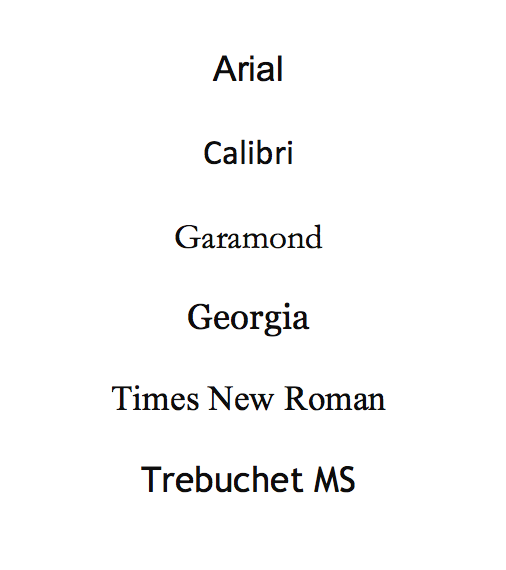
Here are some favorites and generally acceptable fonts, in alphabetical order:

Arial – clean and easy to read, safe choice, which some may view as boring

Calibri – the default Microsoft Word font, very familiar

Garamond – old style font, timeless, polished elegance

Georgia – traditional alternative to Times New Roman

Times New Roman – universal font and very popular résumé choice, also safe like Arial

Trebuchet MS – sans serif like Arial, a bit different but still comfortable for the reader

Résumé Fonts

A few more points before I close:

  1. Uncommon Fonts. If you choose a less common font, make sure the text is highly readable and accessible by most users of Microsoft Word and other word processing programs. The worst case scenario can come true – your font is not supported, and your document looks like a mess on their screen.
  2. Use of Space on the Page. If space is an issue in your résumé (either you have too many words or too few), the font can change the entire look of your document.
  3. Limiting Your Font Use. Don’t use too many fonts within the document. It doesn’t look fancy, it looks disorganized. I generally suggest only one font. If you use a second one as an accent, be sure to use it consistently throughout the document (i.e., only for your name and contact information on both pages). The same rule applies for capitalization, use of bold, italics, etc.
  4. Colors. Just as you are careful with font, be careful with (and don’t overuse) colors. Again, take a cue from what you have seen in your industry as a proxy for what your target audience will respond to and expect.

If you have any input or questions about fonts, feel free to leave a comment at the end of this post. Thanks!

[Update July 2016: since writing this post, I have also started using Helvetica in résumés, so I’m adding it to my list of fonts. I continue to use Times New Roman generally in the legal field, as it is a font that lawyers are comfortable reading, and often (but not always) use a sans serif font for non-legal clients. I have generally stopped using Calibri as well.]

Copyright 2016 Anne Marie Segal.


The Three Basic Challenges in Any Career

At the heart of the matter, there are only three basic career challenges. How to get somewhere, how to leave somewhere and how to be somewhere.

At the heart of the matter, there are only three basic career challenges:

  • Finding a new job
  • Leaving an old job
  • Performing in a current job

How to get somewhere, how to leave somewhere and how to be somewhere. That’s it.

shutterstock_291297941 (cropped chess pieces)

We go through our daily lives focused on one or more variants of these problems:

Bringing Our “A Game”

Playing to Our Strengths

Interviewing for a New Role

Surviving a Toxic Workplace

Managing Up

Cultivating a Leadership Presence

Setting Boundaries

Changing Fields

Getting Organized

Surviving a Layoff

Gunning for a Promotion

The truth is that each one of us needs to focus on each of these three basic career challenges on a regular basis, whether it is one or more of the variants I mention above or others. We often get focused on the specific “problem at hand, ” and often in a negative way – hating our boss, hating our hours, hating the product we sell, hating our commute, etc.

If you are consistently focused on the micro-issues, you can lose sight of these macro-challenges in your career: how to get somewhere, how to leavesomewhere and how to be somewhere.

As we all know, no job is permanent in today’s world. Even if you love your job or feel that you need (a relative term) to stay with a specific employer for the foreseeable future, your role is constantly changing and your current situation may not be forever. Being in a role, i.e., drilling down to understand what your company or organization is seeking to accomplish and how you can play a greater role in its continued growth and success, is a skill that is infinitely transferable and, in fact, the most important career skill one can have.

Many of us, however, are locked into the particular career problem de jour without keeping our eyes locked on these medium, long-term and ultimate goals. Others only muse about they would like to do or be next, without taking the time to consider logically each individual step to get them there or asking themselves how they can perform better in their current roles. If you fall into either of these camps, you will suffer from disengagement from your career, because you have relinquished the power to drive it. You may have your hands on the wheel, but your can’t ascertain your speed or direction.

Rather than thinking of each of these three basic career challenges (where you are going, what you are leaving behind and how to live in your current role) as individual hurdles, envision your career as a continuum. Each challenge provides the context for the others, and each stage of the process sheds light on the other stages.

1) Finding a new job

What is your target? Do you have clear focus on what you are seeking and why (specifically, what differentiates a new role from those you have previously held)?

If you can’t see what’s on your horizon, what can you do to gain focus? Exercises that help you clarify your own values and value proposition are very helpful in this regard, as is working with a career coach or mentor. (But remember that mentors, and some coaches, have their own biases and blind spots.)

Along with your increased focus, what can you do to present yourself as a compelling candidate? Your résumé is a core document, but don’t forget about cover letters, deal sheets, bios, websites and LinkedIn, to the extent that any of these can help you advance your goals. Beyond the documents, networking and interviewing skills are key, and they both build on the same principles of presenting ourselves well and being able to translate our message to our target audience. These “personal branding” muscles – to use a current buzzword – are ones we should be exercising every day, so they are strong when needed. Lastly, remember that the best momentum comes from what you are already doing – the current aspects of your professional life, written broadly – and that means all of your career accomplishments, talents and transferable skills, not only the obvious ones.

2) Leaving an old job

If you are familiar with change management, you may already recognize that all change involves loss, even changes from which we stand much to gain. Practicing the art of letting go and visualizing yourself in a changed space before you want or need to leave a job will help prepare you for taking that leap. If the choice to leave is yours, these actions can also help give you the motivation to make the change. The worst place to be in a career (relationship, etc.) is unhappy with where you are and unmotivated to do anything about it, which becomes a cycle that is hard to break. Staying attuned to the art of moving on and aware that you have the power to re-create your own circumstances are decisive factors in your career success.

In addition, even before you are on the crux of leaving a role, think about who and what will be left behind. How can you put yourself in a good place each day, as if it were your last day in the role? One example of such preparation is to cultivate key relationships that you would like to maintain after you leave. Another is to resolve or mitigate any disputes that should not be left to linger, if possible. The world gets metaphorically smaller each day, and former work colleagues can easily become future ones, sometimes for the better. In addition, if your new role will be within the same organization (e.g., a promotion), you will get more help, input and support from former colleagues by creating meaningful relationships before the change and maintaining them after your move. Even if certain colleagues seem to have no visible impact on your new position, you can never truly estimate or measure the value of having a solid base of supporters for your cause.

3) Performing in a current job

First, there’s the art of mindfulness and “being in the moment” to be truly productive, connected and alive.

Second, you really can take it with you. By that I mean that whatever progress you make in a current role, you are not only advancing the goals of your company or organization, you are also growing yourself. Unfortunately, as a career coach, I see firsthand how this is something we can easily miss. As I work on résumé writing with clients, for example, I often find they have not “connected the dots” on how their contributions and experience make them compelling candidates to their target audiences. I approach the résumé writing process not only an exercise in putting the right words on the page, but also in formulating the client’s strongest message (i.e., values and value proposition) in the first place.

Last week, for example, I worked with a client who had a junior-sounding “compliance analyst” role on her résumé. As we spoke further, it became clear that (at her relatively small company) she had not only drafted documents, trained staff and the like, she had also essentially co-lead the creation and formalization of the company’s compliance program. While her current role was not where she wanted to stay, it gave her a realm of tools to bridge and bootstrap to her next move. In addition, as she continued to stay fully engaged in the role, she then brought the company through a series of risk-reward analyses and improvements designed to laser-focus their risk-mitigation efforts on the changes that really mattered to their viability and bottom line. I gave her the language to discuss her experience in a larger context, and with that context she is able to more fully leverage her value proposition.

This client’s lessons, successes and wounds – garnered from the process of discerning, persuading and negotiating game-changing measures across business teams and other functions – will serve her well in any future career. As you reflect on your own career, you may find the same hidden gems are planted as you remain engaged and present, for your employer’s growth and your own.

Copyright 2016 Anne Marie Segal.

Originally published as “The Three Macro-Challenges of Your Career” on LinkedIn Pulse.

Should You Really Start Something New in the New Year? (Hint: There’s Another, Sometimes Better, Option)

shutterstock_90761039

We are accustomed to think of the New Year as a time to start something new.

New Year, new thing. It makes sense.

But what if you took a step back and looked at the change of year not as a chance to do new things, but to bridge the old and the new? What if, instead of starting something new or resolving to make a change, you threw yourself into something you already do well, but you do it better in the New Year?

So here’s a short visualization exercise, since this only works if you are dealing with what’s truly personal to you. If you wish, write down five things you already do that are working. This can be for your business, career, personal life, health, etc.

Write down five important things. (It’s better to actually write than just think. Seeing words on the page makes them real.)

Five Things I’m Already Doing Well

1.

2.

3.

4.

5.

Now, write down why these five things are working. What results are you getting from these actions? Are these results that you want to continue to see in the New Year?

Why These Five Things Are Working

1.

2.

3.

4.

5.

Finally, which one(s) are most important to continue doing, so important that you should not only keep doing them, but also invest more time and dedication to them, to do them even better and get stronger, more lasting results?

Things to Ramp Up in the New Year (and How to Do It)

1.

2.

3.

4.

5.

When we are young, it makes sense to continue to try something new every day, season or year. As adults, sometimes that is the right answer, if it breaks us out of bad habits. But many times, the more fruitful course is to build on what we already know or a change that we have already set into motion.

When we do something new, we expand our horizons. When we recommit, we invest in our strengths. Which one makes sense for you in the new year?

Anne Marie Segal is a career and leadership coach, author and resume writer..