General Counsel and Other Lawyers as Business Partners – Building Vision, Capacity, Judgment and Leadership

To succeed as General Counsel, you need not only to build relationships and move outside of what may be your comfort zone – a lawyer with excellent substantive legal skills – but also position yourself as a strategic member of the leadership team. Enclosed is a list of articles to help you explore and master the expanded General Counsel relationship.

Eight Core Qualities of General Counsel and How to Achieve Them is my most-read article on this blog, receiving many hits per day and more than 2,500 views since it was published in the late summer of 2016. (Click here to access the article.)

As a coach, I often receive requests from General Counsel, Assistant General Counsel and other in-house attorneys – as well as law firm partners and others who wish to obtain those roles – to coach them on building their capacity and visibility as a business partner within an organization.  Both of these aspects are important – exercising the right proactivity, judgment and skills and being recognized and rewarded by the Board and senior management for such contributions. This involves not only building relationships and moving outside of what is commonly called one’s comfort zone – a lawyer with excellent substantive legal skills – but also learning how to position oneself as a strategic member of the leadership team.

AdobeStock_131225997 (woman GC or CEO).jpg

To succeed as General Counsel, you need not only to build relationships and move outside of what may be your comfort zone – a lawyer with excellent substantive legal skills – but also position yourself as a strategic member of the leadership team.

I intend further explore the expanded General Counsel role in the coming months, so please subscribe to my blog or sign up for my mailing list if this is a topic that moves you. In the meantime, I have started to compile a list of articles around the web from recent years that have addressed the evolving General Counsel role, which I am posting below to help you explore and master the expanded General Counsel relationship.

If you hold a CEO, CIO, CFO, COO, CTO, General Counsel, law firm or other role and would like to post another resource in the comments or join the conversation, I appreciate your input.

I may update this list from time to time. Thanks in advance!

Attorneys – General Counsel and In-House
Vision, Judgment, Capacity Building and Leadership

Eight Core Qualities of Successful General Counsel and How to Achieve Them,” Segal Coaching Blog, Anne Marie Segal.

So You Want to Be General Counsel? How to Maximize Your Chances,” ACC Docket, David M. Love III, Mark Roellig.

Do Lawyers Make Better CEO’s than MBAs?,” Harvard Business Review, by M. Todd Henderson

The General Counsel as Senior Leader: More than “Just a Lawyer,” Korn Ferry Institute, John Amer.

What GCs and CCOs Can Learn from Each Other,” Thomson Reuters, Thomas Kim.

An Open Letter to GCs and Law Firms,” ACC Docket, Daniel Desjardins.

General Counsel: Guardian and Conscience of the Company,” Forbes, Mark A. Cohen.

The Rise of the General Counsel,” Harvard Business Review, Ben W. Heineman, Jr.

General Counsel’s New Role: Business Strategist,” Forbes, Brian Jones.

Anne Marie Segal is an executive coach, writer, resume strategist and former practicing attorney (including as a law firm partner and Deputy General Counsel of a private equity and hedge fund). The majority of her clients are senior attorneys, and she has coached hundreds of professionals across law, finance, engineering, technology, marketing, non-profits, government and other fields.

Anne Marie is also author of Master the Interview and the newly published Know Yourself, Grow Your Career: The Personal Value Proposition Workbookavailable at Amazon, Barnes & Noble and other retailers. 

Click on a sharing option below to share this post on LinkedIn, Twitter or other social media sites. Please leave a comment if you want to join the conversation or share an article, video or other resource for the list.

Image credit: Adobe Stock.

Melanie Glover on Stepping Out of Your Comfort Zone (Guest Post)

Every time I have pushed myself outside of my comfort zone, it has hurt. But I have not once regretted it.

girl on a rock
Stepping Out of Your Comfort Zone (Adobe Images)

I welcome my first guest blogger, Melanie Glover, a personal friend on the career path journey. Melanie is a young attorney and certified personal trainer who writes about professional development, health, nutrition and exercise at Balanza and Beyond.

Melanie Glover
Stepping Out of My Comfort Zone

Every time I have pushed myself outside of my comfort zone, it has hurt.  But I have not once regretted it. 

It was the beginning of my legal career, and I had to cover a hearing for my supervisor.  The hearing was supposed to be simple and straightforward.  It was not supposed to take long.  However, everything turned out how I least expected. 

The hearing that was supposed to last five minutes lasted five hours as I waited for other attorneys to take their turns with their clients before the Judge.  I came back a second and then a third time; I went back and forth with the Judge on the record; and I interacted with my client.  I was not prepared for that marathon day in Court when what I had been expecting was a five-minute hearing.  At the end of the day, I just wanted to hide:  despite my all-afternoon efforts, we would have to appeal.

I confess:  I felt like I had let my client and myself down. 

The hearing was supposed to last five minutes.
It lasted five hours.

Then, after several months, I took a step back and reflected.  I learned practical things, such as (1) always to take my Statute with me to Court, and (2) to always be prepared for a hearing to last all day. 

But I also learned a deeper lesson to apply to life in general both in my professional and personal lives.  I learned that undesirable situations might just bring a person to the edge of discomfort only to come out on the other side with a fresh perspective, a new relationship, or some other productive and creative energy or opportunity.

That day I felt less than my best self in front of my colleagues, the Judge, and my client.  But after further examining the experience, I realize that I also made a valuable friendship with another attorney who went through the same experience by my side.  And out of that friendship, I have been able to commiserate, receive advice, and even give advice.  In summary, I have learned that even what seem to be the most challenging situations at the time can still produce hope; you just have to look – and practice looking – for it.

When we reflect, we learn.  And when we fall, we do not have to stay defeated.  We can stand back up, and we can learn from the tumble.  Coming to a positive conclusion after enduring hard circumstances is not comfortable.  In fact, it can be a bit reckless; but it is unexpectedly worthwhile. 

When we fall, we do not have to stay defeated.
Search for that unexpected gift.

My overarching advice for young professionals is to search for that unexpected gift – a lesson, relationship, or new skill – in difficult circumstances.  Searching deep and wide for the good within the bad is definitely a practice that I have had to acquire intentionally.  But those trying situations have allowed me to practice seeking the underlying positive message despite the adversity. 

Guest post insert and image © 2016 Melanie Glover. All rights reserved. Originally published at Balanza and Beyond on July 22, 2016. 

1468170729742 (melanie glover)

Melanie Glover is a young lawyer and certified personal trainer who blogs about creating a healthy, balanced lifestyle through tips on fitness, nutrition, and self care.  Her blog is a personal endeavor to help others become the best versions of their personal and professional selves and can be found at Balanza and Beyond. Melanie’s book on an American’s view into a Spanish kitchen, Fusión Cultural, is available on Amazon. 

Attorneys: Your LinkedIn Headline in 120 Characters or Less

You have 120 characters in your LinkedIn headline. (No, not 140. That’s Twitter.)

120 characters to sell yourself to the world. Yes, I said sell. LinkedIn is not where you find enlightenment. It is where you find clients, contacts or a job. If you are not already, you need to be crystal clear on the distinction, whether or not you like it.

Important Update in 2017: Following Microsoft’s acquisition and restructuring of LinkedIn, many of the features have changed. For example, only a portion of your headline and the first few words of your summary are visible in many cases until someone clicks to see more. This makes is critical to have the essential information that reflects your value proposition – or otherwise draws people in – right at the top. You can check this out for yourself by accessing your own profile through various devices.

So what should it say?

Should you opt for something short, try to get in as much as possible or meet somewhere in the middle? How “out there” should you be with your job search?

I hear these questions from clients every week, if not every day. One of the main goals as a résumé writer is to help my clients see how they appear to a third party, especially a potential recruiter, hiring manager/partner, interviewer or other job search facilitator. We are often so wrapped up in our own stories that we forget how we appear to the outside world.

Take a look at a range of possible headlines below, which could easily describe the same individual at various points in his/her career. Depending on how he/she wanted to be perceived, some of these headlines are clearly more effective than others.

Can you immediately tell which ones?

– Scroll down for commentary –

Capital Markets Attorney, Counsel | Derivatives | Global Funds | Dodd Frank & EMIR

ISDA/Derivatives Attorney

ISDA Attorney | Derivatives Counsel

ISDA Attorney | Derivatives Counsel | Hedge Funds

ISDA Attorney and Derivatives Counsel at [Name of Employer]

ISDA Attorney at *

ISDA Attorny [sic]

Contract Attorney

ISDA Attorney Seeking New Opportunity

Attorney Seeking a New Opportunity

Versatile & Business Savvy Senior Attorney with 20+ Years of Effectively Resolving Complex Issues and Managing Risk

Senior Business Savvy Attorney

Experienced lawyer seeking engaging legal employment

Attorney, actively seeking employment

VP, Legal

Vice President and Associate General Counsel

Associate General Counsel

Financial Transactions Attorney

Corporate Finance Professional and Attorney | Investment and Corporate Banking

Attorney | Advocate

Attorney

Financial Services and Trading Counsel

ISDA Counsel and Negotiator

Experienced Derivatives Attorney and Published Novelist

Attorney/Writer/Humorist

Clearing, Dodd-Frank & ISDA Attorney

Fixed Income and Derivatives Attorney, Contracts Negotiator

ISDA, Prime Brokerage, Securities Lending, Repurchase, and Futures Negotiator

Derivatives Attorney

ISDA/Futures/Derivatives Attorney

Financial Transactions Attorney

Senior Derivatives/Regulatory/Capital Markets Attorney

– Commentary –

Clearly there is much more to say than I can cover in a short blog post, but here are some general thoughts to guide you:

First, consider your audience. You’ll see that I highlighted some headlines above. Two of them are “hybrid” (the last two headlines highlighted in red above) in that they straddle multiple roles – legal and writing. This can be effective if you are actually selling yourself to both audiences, and you do not believe that presenting yourself as a hybrid will do damage to your brand. It should, in fact, support your brand, because it reflects how you present yourself in daily life. Again, LinkedIn is not about self-actualization or gratification, it is about presenting yourself to the world in a professional context.

Second, an incomplete headline (or one with errors) is probably the worst thing you can do. It reflects extremely poorly on you, because it implies that you will lack attention to detail in your daily work as well. The first two highlighted headlines above display this lack of care. In the first, the attorney did not realize that LinkedIn prompted an employer, so it simply ends with “at….” (The added asterisk is mine.) In the second, the word Attorney is spelled incorrectly! I would not trust you to draft a contract to purchase a popsicle stick, let alone a multi-million dollar transaction, if you can’t even spell your headline correctly. Yes, I have actually seen typos in headlines, although more often they are in the summary or elsewhere on LinkedIn.

Third, if you have a temporary job, you are not a “temporary person.” You do not need to sum up your current employment. Instead, your headline should indicate who you are, not your present role. To that end, I would avoid a headline like “Contract Attorney” at all costs.

Fourth, don’t sound desperate. I see many headlines that announce an individual is “seeking employment,” even in some cases for individual who appear to be currently employed. While I cannot say that there is no case in which this could be appropriate, in most fields, including law, you should eliminate this from your headline. There is an old adage that it is easier to find a job when you have a job. The same applies here. As a hiring manager, I would rather hire individuals who are self-confident in who they are and what value they add than those that appear they will take the next best “new opportunity” that presents itself. Among other reasons, I would not be convinced that, once hired, the person would stay.

Fifth, don’t try a subtle, back door approach that imitates #4 above. By that I mean a headline like the following:

Versatile & Business Savvy Senior Attorney with 20+ Years of Effectively Resolving Complex Issues and Managing Risk

If you read between the lines, this person also is clearly on the job market. There are so many things wrong with this headline that I don’t even know where to start. Here are two:

(1) It has a lot of words without saying much.

(2) Words like “20+ Years of…” scream résumé, so they announce your job search. In the case of this individual – this is a real LinkedIn headline – he also has clients who may be turned off by this presentation. You are always writing to your current situation as well as your target next role (if any). The headline also screams “keywords” although it is not clear that they are the right words.

(Note: You may also not want to highlight your implied age by stating 20+ years – a separate issue that I’ll cover in another post. In the résumé business, the unwritten rule is to go with 15+ years, although there are clearly exceptions.)

Sixth, always remember keywords. While you generally don’t want your current employer to know you are looking for a new role, you also want to have a headline that describes what you do and will cause you to be located when a recruiter or other individual conducts a keyword search, if possible (even if you have no intention of leaving – who knows what dream job awaits?).

This is another reason why “seeking employment” does not help much. If you have “employment” and “attorney” in your headline, you may come up in searches for “employment attorney” but not in searches for your substantive experience (e.g., derivatives, contracts, etc.). This can be cured somewhat with a robust summary or other sections of the LinkedIn profile, but the headline is a stronger place for this identifying information.

Seventh, a difficult situation arises when you are trying to sell yourself in many ways.  Sometimes you do not want to pigeonhole yourself as a particular type of attorney, especially if you are looking to transition or branch out. This is when you should consider whether to write a “tighter” or “looser” profile, i.e., one that identifies you more as an expert in a specific area or one that paints a broader brush.

One last note about adding the name of your employer to a headline: Often it takes up valuable “prime real estate” because it is not a keyword. However, if you work at a highly recognizable and well-regarded employer – from Goldman to Google – or an emerging company or organization known for innovation or another key quality that matches with your brand, it may well be worth including part or all of the name in your headline. 

In summary, it is your headline, so you should be comfortable with it. There is no one right answer. After considering the above, also consider what your gut tells you. Would you be comfortable presenting your headline across the various audiences that will see it? Will it raise your confidence level and appropriately broadcast your professional self to the world? I suggest you take a look at your headline again with all of these hard and soft factors in mind to find the one that is right for you.

Copyright 2016 Anne Marie Segal. All rights reserved.


Becoming a Corporation: How to Transition from “Me” to “the Company”

[Note: This post was written while I was a practicing attorney running a solo law practice. Since April 2015, I have been working with attorney, executive and entrepreneur clients as a career coach and writer, and I am not currently available for legal engagements.]

A client of mine recently received her filing receipt evidencing incorporation in the State of New York. Her astute next question was “now what?” She had been carrying on business in her own name and wanted to know how to begin conducting her activities as a corporation.

She was asking, in other words, “how do I transition from me to the Company?”

This is a great question. I am sure that, by knowing to ask it, this client is off to a great start. One of the most important features of a corporation is that is generally offers limited liability, so corporate protocol must be followed to make sure the corporate structure is respected. This is often called “i’s” dotted and “t’s” crossed. In practice it means, among other things, that:

– company and individual activities are kept separate (especially in cases where money is involved),

– the company’s board of directors (“Board”) and officers do what is expected of them (and each individual role is respected), and

– the company follows the direction of the Board and Chief Executive Officer or, as this title may be designated at a nonprofit entity, Executive Director.

IMG_8955

Here are some of the important, initial steps you will need to take. There may be others in your home state and for your particular entity and activities, but these are generally universal:

1) If you were the sole incorporator and have not yet elected a Board or have until now filled all roles, you will need to elect your Board. It is generally preferable to have at least five Board members, although you can start with a smaller Board and expand if you only have a small core group of dedicated directors at the beginning. Choosing your Board is one of the most important decisions of a young organization. You should give careful consideration to who will best advance the organizations’s goals and take their roles and duties seriously.

Electing the Board – or expanding the Board – is done at an organizational Board meeting and recorded in the minutes of the meeting. Alternatively, Board members can be elected by unanimous written consent of the Board.

2) The Board, in its organizational meeting or via written consent, will also elect officers of the corporation. Core officer roles are generally President, Secretary and Treasurer. A Vice President is also commonly elected to serve as an alternate to the President. In some states, these roles can all be filled by one individual, although generally that is not recommended to avoid potential conflicts of interest and provide for good corporate governance.

3) If you have already undertaken activities in your individual name or as an incorporator – such as incorporate or make some initial payments to third parties – it may be that the Board needs to review and ratify your prior actions. For example, the Board would ratify and approve the incorporator(s)’ act of forming the corporation.

If your prior activity has been substantial, it is possible that that only certain activities should be ratified, and this may depend on the nature of the activity and ongoing relationships. At the same time, if there are contracts in your individual name that should now belong to the company, these may need to be assigned to the corporation or terminated. It can get complicated if there has been substantial activity or in certain circumstances, so if you have any doubt, speak with a business attorney about how to sort this out.

4) The Board should also authorize other important actions to be undertaken by officers of the corporation, such as applying for an Employer Identification Number (EIN) and opening a bank account. (Note that the IRS now allows a company to apply for its EIN online. Click here.)

5) The newly-formed corporation should also draft and adopt bylaws, which the Secretary of the corporation will insert into the minute book along with the Certificate of Incorporation, all board resolutions and other important corporate documents. I suggest to my clients that they keep an electronic copy of all documents as well as paper copies, even if the laws of their home state allow for only electronic versions. In the digital database, care should be taken to name files in an identifiable manner and to keep the documents secure. The contents of the bylaws should reflect what the corporation will actually do – not simply be copied from a form – and it is a best practice to have a copy at Board meetings to which the directors can refer if needed.

6) State and local tax law matters and registrations need to be addressed.

7) The corporation should put basic policies in place, such as a conflict of interest, whistleblower and document-destruction policies. Over time as the company grows, these policies may be worked into an employee handbook.

8) The corporation should hire an accountant or bookkeeper – or designate someone with expertise from within its ranks – to keep track of revenues and expenses as well as tax and other deadlines.

The above steps provide an overview of certain important first steps for a new corporation. Depending on the nature of the organization, there may be other important steps to consider, but as a minimum these steps should be followed. As discussed above, these are not simply “formalities” but rather will allow for effective governance of a corporation and go a long way toward preserving limited liability for its directors and officers.

None of the information posted on this site constitutes legal advice or forms an attorney-client relationship, and there may be facts not discussed here that are relevant to your situation.

Never, Ever Unstaple a Will (And Did I Mention Never, Ever?)

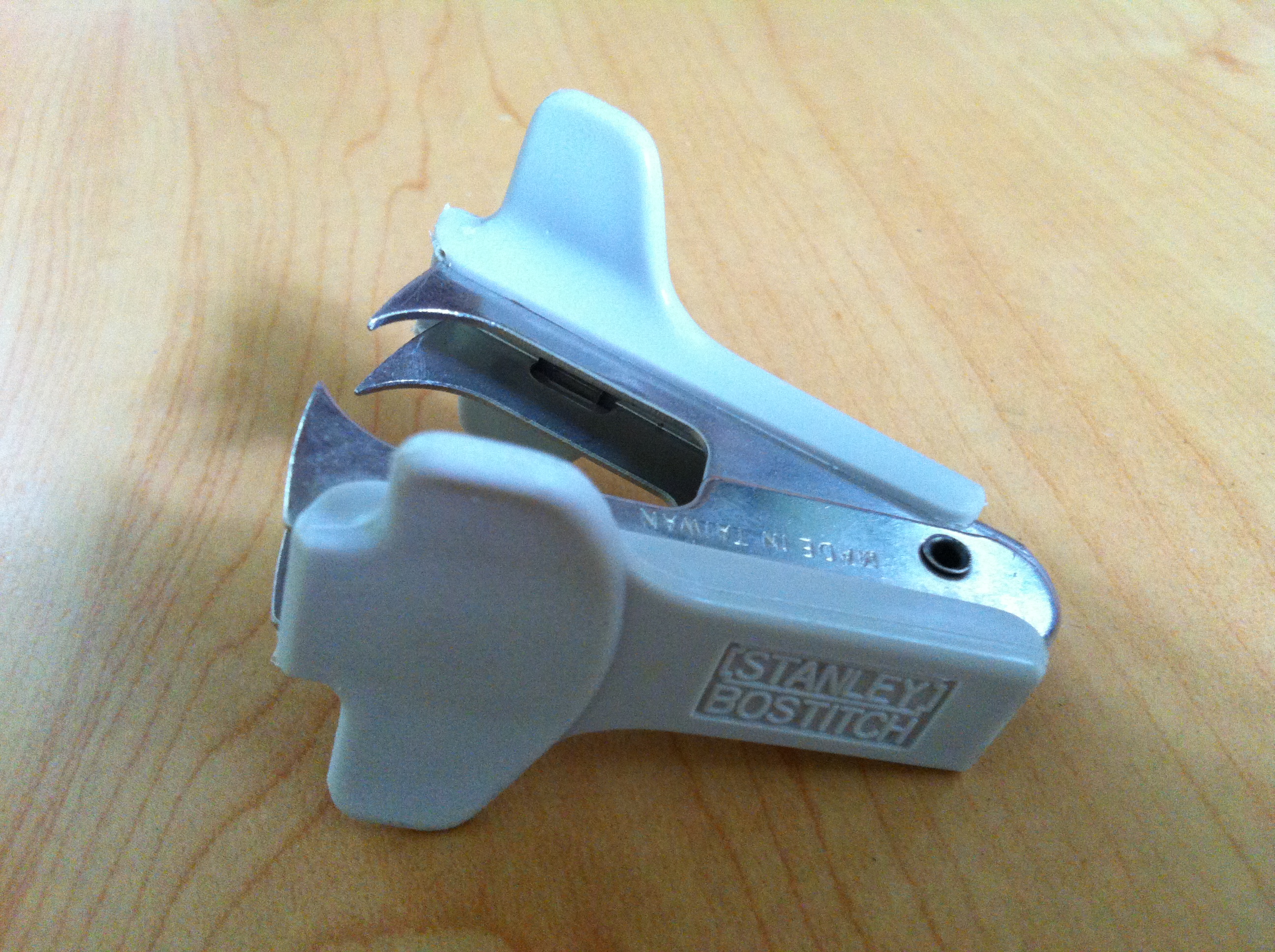
Who would have thought that a small and simple object that (can draw blood if squeezed into a finger but otherwise) appears relatively harmless could blow your entire estate plan?

The common staple remover. An enemy of well-drafted last will and testaments and well-made estate plans nationwide.

photo-19

[Note: This post was written while I was a practicing attorney running a diverse solo law practice, and it is one of a small number of “legacy posts” that I have retained on the site. When published, this was one of my most popular posts. Since April 2015, I have been working as an executive coach and writer, and I am not currently available for legal engagements.]

Here’s what I tell my clients:

Never, ever unstaple a will. Never, ever, ever. And did I mention never, ever? Don’t do it!

To drive home the point with a memorable comparison, I even have joked with some clients on occasion that unstapling a will is like having an affair. (I only say this when I am pretty well assured the joke will be properly received.) You can try to put it – i.e., the marriage or the will – back together again, but it will never go back exactly the same as it was before. There are always some holes that cannot be filled and some room for distrust that it is difficult to overcome.

There are always some holes that cannot be filled and
some room for distrust that it is difficult to overcome.

Unstapling a will can call the entire document into question. Was a page added or removed? Is it a complete and properly ordered copy? Even if the pages are numbered and initialed, how can we (sometimes many years later) be sure that no one did an artful yet fraudulent switch of parts of the document he/she did not like?

It is such a serious issue that, if a will is to be proven in probate court as the correct, complete and valid original last will and testament, there is a process of submitting an affidavit by the person who unstapled the will, discussing the reason for the unstapling, when and how it happened, and by whom. The court is understandably concerned that there was no foul play involved, and wills with multiple staple holes are regarded with suspicion.

So what should you do instead, if you need a copy of your will?

If you need a copy of your will, you should make a copy of a copy, not of the original. Or you can make a copy of the original without unstapling it, making sure that you do not damage any of the pages in the process. It’s not a good idea to have too many copies of your will floating around in any case, since you may wish to change it later and do not want someone with an older copy trying to challenge the later will. If you have any doubts, contact your local estate planning attorney before taking action that can have serious legal consequences to one of the most important documents in your legal life.

So let’s not forget. I repeat:  Never, ever unstaple your will! Never, ever!

None of the information posted on this site constitutes legal advice or forms an attorney-client relationship.

Safe Deposit Box: Best Place to Keep a Will?

A safe deposit box seems like the perfectly logical place to store a will and other estate planning documents. They are probably the most important documents we will ever have, so shouldn’t they be kept in the safest place?

But is it a safety deposit box the best place? Or should you keep it in a fireproof safe in your home? With your lawyer? The court? Or somewhere else altogether?

[Note: This post was written while I was a practicing attorney running a diverse solo law practice, and it is one of a small number of “legacy posts” that I have retained on the site. When published, this was one of my most popular posts. Since April 2015, I have been working as an executive coach and writer, and I am not currently available for legal engagements.]

Although I mention it again below, this bears stating here at the outset and repeating: Whatever option you choose, make sure your executor knows what you did!

Safe Deposit Box

Although clients often instinctively want to put wills in a safe deposit box, many estate planning lawyers suggest not to keep a will or other important estate planning paperwork there.

photo-14

The problem arises with the fact that many states seal a safe deposit box when informed of the death of the owner, and a court order must be issued to request that the box be opened to search for the will. Although probate courts will generally issue this order “immediately”, in practice there is still a delay until the request is made to the court (or the court acts on its own) and the order is actually granted.

Documents that are generally allowed to be released include the will, any deed to a cemetery or burial plot and any life insurance policy for the named beneficiary. I mention below (by way of example) some basic information about two states, Connecticut and New York, although more complete and updated information may be applicable if and when it is needed by your heirs. Following this information is a discussion of other options for keeping your estate planning documents, such as with an attorney, with the court or in a fireproof safe in your home.

Connecticut

In Connecticut, there is a standard form to request that a safe deposit box be opened after the death of an individual (click here), which should be submitted to the decedent’s corresponding court of probate. The form may be submitted by a next of kin, spouse, or any person showing a sufficient interest in the presence of a will to obtain any will or cemetery deed in the safe deposit box. The court may also issue an order ex parte. In all cases, an officer of the bank must oversee the process and report back to the court.

New York

Surrogate Courts in New York have different forms depending on which court is issuing the order. (New York tends to be more complicated in many legal matters, unfortunately.) Here’s the form for Queens County, for example (click here). To its credit, New York has made it easier with a do-it-yourself program, called the Surrogate’s Court Safe Deposit Box Petition Program, to walk people through how to make the request (attached here). Among other documents, you will need to obtain a copy of the death certificate before making the request.

Bank Procedures

In addition to the above, a bank may have its own procedures, such as requiring Letters of Appointment, Letters Testamentary or Letters of Administration (each being a letter allowing an executor or administrator to act on behalf of the decedent’s estate) before allowing access to the safe deposit box.

As you can see, there administrative hassles involved (those discussed here and others) with storing a will or other estate planning documents in a safe deposit box. That said, for individuals who do not have another safe place to store a will or prefer the safety of a safety deposit box, it may be the best choice.

Lawyer’s Office

Another option is to keep a will with the attorney who drafted it. Again, this may or may not prove as easy as it sounds. For example, we had wills drafted by an attorney shortly after the birth of my first child. After five years the lawyer wrote to us stating that the originals would be sent back to us if we did not inform her that we wanted her to keep them. (But I thought she was going to keep them until we died?)

In addition, offices may move or close, and if you do not keep careful records, it may be difficult for your heirs to locate an original will when the time comes.

The Internet does help in this regard, but it is not foolproof. I represented a client recently who had drafted her first will many years earlier and wanted to update it, changing her executor and adding grandchildren as beneficiaries. We attempted to locate the attorney who had drafted the original will, even contacting a lawyer who had previously shared office space with him and sending out email blasts to estate planning attorneys who might have known him. The man was nowhere to be found. He had either retired or passed away himself. Needless to say, if my client had died without updating her will, her heirs would have only had a copy to submit to the court (that is more open to being contested and requires additional proof to be probated), not the original.

Finally, if the lawyer is not responsive for whatever reason, executors or others seeking to obtain estate planning documents from the attorney may also need to obtain a court order to compel production.

Again, a lawyer’s office may be the best place to store a will, depending on your circumstances. However, you should weigh all factors for and against before making a decision.

The Court

You can file your will with the court in many states, which is also a safe option, but this means that your will becomes an official document, not a private one. If you decide to change the terms of your will, you cannot get it back, so beneficiaries and former beneficiaries can see how their respective inheritances have changed (or been removed) during successive revisions. On the contrary, if a will is a private document, you can destroy the original and all copies, and would-be heirs who have fallen out of favor are none the wiser.

In addition, if you move out of the jurisdiction of the court, out of state or even out of the country, your court-filed will does not come with you. There should only be one original of your will (an inviolate rule, barring very specific cases of different wills covering different assets, such as an international circumstance). That means if you drafted a will while living in Westchester County, New York, and filed it with the Surrogate’s Court in White Plains, your executor and beneficiaries would need to obtain it from that court, even if you or they have since moved to Phoenix, Paris or beyond.

Fireproof Safe in Your Home

It may be, after considering other options, that you decide to keep your last will and testament in a fireproof safe in your home. This is often a good option, especially if you have a safe that cannot be remove from the premises by anyone seeking to tote off valuables. In that case, I would recommend keeping a copy of the will in a safe deposit box (clearly marked COPY, with instructions on where to find the original), in the unfortunate circumstance that the original is lost. Be careful not to create too many copies, since you may later revise important provisions of your will and do not want multiple prior copies floating around that a beneficiary with a reduced share tries to “prove” is your correct and valid last will and testament. This can happen even among otherwise friendly parties, such as children and grandchildren. Do your heirs a favor, and keep everything clean to mitigate potential conflicts.

The Freezer

According to the rumor mill, there may still be a few folks who actually store important documents in the freezer. I have never met anyone who did – maybe it’s a poor man’s safe? – but I certainly don’t suggest having a last will and testament shoved behind the frozen peas. Not only does it sound a bit too Sopranos to me (and James Gandolfini himself left a mess for his heirs), but the bag it’s stored in better be really, super waterproof in the event of a power failure.

Let Them Know What You Did

Regardless of the option you choose for storing your will, make sure that your executor(s) know what you did. The best estate plans only work if the right people know how to follow them and where to locate essential documents when the time comes.

None of the information posted on this site constitutes legal advice or forms an attorney-client relationship, and there may be facts not discussed here that are relevant to your situation.