Old Dog, New Tricks: What Can You Change Before Year End?

Happy businesswoman jumps in the airport

Most of us, thankfully, do not need to learn a new form of martial arts to effectuate the change we want to see in our lives. It could always help, yes, but it’s not the natural next step.

Yet we do have something eluding us. A piece of the puzzle we have not yet fit, and we cannot reach the next goal (even one we have been desperately seeking) without finding and placing that piece.

But human beings are stubborn. I know I am. And yes, I’ll say it, some of my clients are stubborn too.

Too often, we know what will serve us – what we need to do, so we can do what we want to do – but we make excuses. We are like old dogs who refuse to learn new tricks.

AdobeStock_217290201 (old dog).jpg

So here’s what you do to change that:

(1) Take some time to chill. (Relax, settle in and create some emotional space.)

(2) Review what you wish to bring into your life, and articulate your top goal between now and year end. If your goal may not (or cannot) be completed by year end, choose a manageable goal that is a piece of a larger goal, and repeat these steps in the New Year. For example, rather than “get a new job,” your goal may be to take certain concrete steps toward that end. Focus on what you can change, without attachment to outcomes.

(3) Embrace the vulnerability that you need to move out of your comfort zone. Be prepared to fail, but also be prepared to succeed. In fact, redefine success as a series of steps, not only as an end point.

(4) Embrace the power that you can call forth, from the depths of your being, to reach your goal.

(5) Envision all of the ways you (yes, you) and your family, friends, team, community and/or others. will be better off when you have reached your goal.

(6) Build a support network for your change, even if it’s only one person. Ask them to hold you accountable at each step.

(7) Be curious about what you need to reach your goal, and take the time to explore the most efficient path for you to get there. 

(8) Focus on the present. Not what you could have done last summer, last year or five years ago. What can you do now to achieve your goal? Keeping yourself in the present keeps your emotional energy available for solutions rather than stressing.

(9) Create a realistic action plan and work your plan. Reverse engineer your possible investments and divisions of time and energy to prioritize this goal among other obligations.

(10) Be your own best fan. Cheer yourself on, and celebrate your wins in a way that is meaningful to you.

AdobeStock_248045295 (joy).jpg

Focus on what you can change, without attachment to outcomes.

In the career context, your goal may be to build something, such as:

  • Resilience
  • A Calmer Demeanor
  • Relevant Skills or Expertise
  • A Stronger Professional Network
  • Gravitas and/or Greater Recognition in Your Field

Choose the goal that’s most pressing for you, and stop giving yourself excuses! Feel free to drop me a line telling me what you have been able to achieve.

Anne Marie Segal is an executive coach, resume writer and author of two well-received books on interviewing and career development. She served as a corporate attorney for 15 years, including roles at White & Case LLP and a prominent hedge and private equity fund manager, before launching her coaching practice. Based in Connecticut not far from New York City, Anne Marie partners with clients internationally on executive presence, impactful communications, graceful transitions and other aspects of professional and personal development. She also offers online instruction at www.segal247.com.

Image credits: Adobe Stock.

The Ultimate Holiday Dilemma: Donut v. Orange (Or, Practical Strategies for Better Decisionmaking)

Today is December 1. We are on the cusp of another holiday season and faced with the age-old dilemma:

How can we make good decisions in a world of tempting choices? 

Donut v. Orange image.png

Whether it’s a diet, career or other choice in the coming days or months, how do we ready ourselves to take the better path… the longer view?

In this short video, I share some key strategies to making better decisions in the face of life’s pressing questions, such as:

How do I choose the orange when I really want the donut?


Follow-up comments or questions welcome. Happy holidays!

Anne Marie Segal is an executive coach, resume writer and author of two well-received books on interviewing and career development. She served as a corporate attorney for 15 years, including roles at White & Case LLP and a prominent hedge and private equity fund manager, before launching her coaching practice. Based in Connecticut not far from New York City, Anne Marie partners with clients internationally on executive presence, impactful communications, graceful transitions and other aspects of professional and personal development. She also offers online instruction at www.segal247.com.

Why We Love (and Lament) Thanksgiving

Thanksgiving, as it is practiced in the countries that celebrate it, is a nationwide day of gratitude. We are called to stop our busy lives and reflect on what really matters to us most. Extra credit is granted if we actually spend time with the people who matter to us, doing the things that matter to us and living in the present moment.

Something inevitably gets in the way. A relative makes a misplaced comment. A loved one would rather watch the football game than engage in heartfelt conversation. (Or, conversely, a loved one would rather talk than turn on the TV.) The food isn’t ready on time. We eat too much and feel like we are going to burst. The dog steals the pie right off the table. A work issue draws us away from the celebration.

Or occasionally, a true, pressing emergency arises.

Each of these distractions, disappointments and interruptions can take us away from the present moment by highlighting a gap between how we imagine Thanksgiving and the reality of what we are experiencing. I know that has happened to me. For many years, I had an idealized version of the holiday, and I worked very hard to meet it.

Distractions, disappointments and interruptions can reveal the gap between our idealized and real experiences.

This year, I stopped working so hard. In fact, I put aside the “work” mindset altogether. I took each moment as it came, each interruption as an opportunity to experiment and each person as they arrived that day.

The dog ate all the pie…? Now what?

If you will laugh about it next year, laugh about it now.

It would be superficial and misleading to say that this mental shift was achieved in one day. I have spent most of 2019 – and indeed, good parts of prior years – peeling back the layers of why I feel the need to work so hard. If I were to universalize the main discovery, it is this:

To simply be present with who and where we are, we need first to be content with who and where we are.

We love (and lament) Thanksgiving because it brings us face to face with this truth. It is the same with every holiday, celebration or tradition that purports to stop time. If we are stuck in cognitive and emotional dissonance – knowing and feeling to our core that our outward life conflicts with what we want and know to be true for our lives – we will not be able to live in the moment. We will constantly be trying to fix things, but they will be the wrong things, because we have not yet closed the gap between our ideal and reality.

Serenity and yoga practicing,meditation at mountain range

When we are not content with our reality, we set up a dichotomy. We imagine that somewhere far away, we could experience a reality that would truly allow us to experience the present moment. Yet the only way to bring that far away place and truth into our current reality is to first be content with where we are today.

Otherwise, we can climb every mountaintop but find no inner peace. We can transverse the globe or drive across three states to visit relatives, friends or sacred spaces yet return tired and spent rather than refreshed. We can do lots of “work” to create an idealized holiday, while we would be better served by embracing the day. We can continue to leave no stone unturned, on a restless quest, ignoring the rich stones in our own gardens.

As we move through the final days of November, turn the page for December and start the New Year, let’s look ahead but also stay present in NOW. Whether it is Thanksgiving weekend for you now, or a regular weekday now, how can you allow your reality to be closer to your vision? What large or small steps can you take to grant yourself freedom, forgiveness, expansive breath and emotional space?

What large or small steps can you take to grant yourself freedom, forgiveness, expansive breath and emotional space?

In my coaching practice, when clients wish to change jobs, we often start with what they can change in their current situation. Sometimes it is an outward change, such as asking for more responsibility in a competency that is highly relevant for their careers and in which they wish to grow. Sometimes it is an inward change, such as creating better boundaries or growing their influence across (and outside of) the organization. We also ask what is working, so they do not lose sight of what they already have.

Taking it back to the holiday season, what feels like an unsurmountable gap between your ideal and reality? How can you close that gap? How can you reflect on the lessons of yesterday and today to create a present moment that serves you?

Feel free to leave a question or comment below.

Anne Marie Segal is an executive coach, business and resume writer and author of two well-received books on interviewing and career development. She served as a corporate attorney for 15 years before launching her coaching practice, including roles at White & Case LLP and a hedge and private equity fund manager. Anne Marie is based in Stamford, CT and serves an international clientele. 

Image above: Adobe Images.


Optimizing Your LinkedIn Profile: Free Resources on Strategy, Headshots and Thought Leadership

Banner - Segal Online 24:7

Optimizing LinkedIn® is surprising complex. It’s hard enough to consider, understand and address:

  • YOUR TARGET AUDIENCE
  • YOUR VALUE PROPOSITION

If you would like help with that effort, you can always take a look at the worksheets I have posted on this site.

After you have a full grasp of these key points, the next challenge is to craft a compelling narrative that draws people in, while understanding how clients, recruiters and/or other potential viewers might use LinkedIn to find and vet you as a candidate.

For your LinkedIn summary and other sections of your profile, there is a delicate balance of including the keywords that will attract your target audience while creating a robust and polished profile rather than a disjointed list of bullet points.

Your next hurdle might be to create an inviting profile photo, for which you can either hire a professional photographer (and even that is not always foolproof, see the checklist below) or learn the principles of portraiture for the LinkedIn format on your own and enlist friends or family to join in your efforts.

A further step is to combine the above strategies with the technical features of the platform, including other artificial intelligence features that drive LinkedIn searches (in addition to keywords) and privacy settings that keep your personal information protected. You could literally spend weeks or months trying to create and implement your strategy and the tactical means to achieve your goals.

You can consider the above a roadmap and take steps each week or month to improve one aspect of your LinkedIn profile. 

If you are taking full stock of your profile and would like some guidance, here are links to some free resources from my Powerful LinkedIn Profiles for Executives and Attorneys course on my online learning site, Segal Online 24/7:

Your LinkedIn Strategy

On Thought Leadership

Working with a Professional Photographer: The Checklist

If you would like to maximize your downtime during the upcoming holiday season and sign up for the full course, keep reading below!

I have a limited number of 20% off coupons available for readers of this blog, if you would like to enroll in Powerful LinkedIn Profiles for Executives and Attorneys.

The coupon code is SAVE20, and you can enter here (while they last). To learn more about the course, including a full brochure, click here.

Anne Marie Segal is an executive coach, resume writer and author of two well-received books on interviewing and career development. She served as a corporate attorney for 15 years before launching her coaching practice, including roles at White & Case LLP and a hedge and private equity fund manager. Anne Marie is based in Stamford, CT and serves an international clientele. 

Image above copyright 2019 Alejandro Barragan IV. All rights reserved.


Thought Leadership Presentation Skills: Compressing Pictures to Reduce File Size in Microsoft PowerPoint and Word

In my work with executives, attorneys and others, I am called upon to act as a coach and help clients reach deeper, expand their vision of their own professional value and capacity and increase their emotional intelligence, versatility, resilience and other key qualities.

I also act as a technical advisor, so to speak, by sharing pro tips that save time (sometimes many hours of time), reduce stress and demonstrate proficiencies that put my clients ahead of the pack. On a recent webinar, I mentioned one of these tips to colleagues in the National Résumé Writers Association, and I have been asked to share it more widely.

So here it is.

If your thought leadership includes public speaking and PowerPoint® presentations, as many of ours does, you may have stumbled upon the common problem of large file sizes that are blocked by corporate and other email addresses.

I ran into this problem myself for a presentation I gave to a group at Wells Fargo, and I am embarrassed to admit that we spent days trying to find creative ways for me to send a large file to them. (They loved the first two slides I sent and were eager for the full presentation.) We tried home emails, SlideShare and other means. I ended up creating an abridged version, but it was still to large (over 20MB), so I had to abridge it even further.

Hours of work to create a visually compelling presentation went down the drain.

We all have had times like these in our professional lives, and we can feel at our wits end. Unfortunately, too often they arise exactly when we are very busy working on other important projects, and we end up not with an optimum solution but a hasty compromise that leaves us feeling stressed and out of sorts. Not the best look when you are the presenter, of course!

I resolved to solve this problem for myself and am sharing it here to give you the benefit of my mistakes. The solution is embarrassingly simple, in fact, and I reduced my file size by more than 20x without creating an appreciable reduction in picture quality.

Click on the video below to learn more.

[Note: I do realize there are enterprise solutions to solve this and other common business and technical problems, but I am often of the view that less is more. How many such solutions can a small business entertain, afford and maintain, let alone an individual? In this case, you don’t need a special service or subscription, as no coding or fancy skills are needed to achieve the result of a smaller file. You just need to know the the trick!]


Anne Marie Segal is an executive coach, resume writer and author of two well-received books on interviewing and career development. She served as a corporate attorney for 15 years before launching her coaching practice, including roles at White & Case LLP and a hedge and private equity fund manager. Anne Marie is based in Stamford, CT and serves an international clientele. Her online learning platform is accessible here.

Video copyright 2019 Anne Marie Segal. All rights reserved.

Introverts + Professional Networking: My Own Story of Networking with (and Finally Meeting) Dorie Clark

If you follow me on LinkedIn®, you might have seen yesterday’s post that, after years of following her work, I finally met a mentor of mine, Dorie Clark, in person. Coincidentally, during a coaching call today with a CFO client about networking, the story of how I first “met” Dorie became highly relevant to our conversation.

I put the word “met” in quotes above, because for a long time my interactions with Dorie were simply online conversations, virtual high-fives and back-and-forth comments, given the busyness of business that we all have come to call life. As my client and I were brainstorming this afternoon about ways she could build out her networking and thought leadership, the idea of leveraging LinkedIn naturally became part of the conversation.

With Dorie’s recent “Land Your Book Deal” workshop and last night’s dinner with her and follow conference participants fresh on my mind, I confirmed that yes, online networking certainly can work, if you choose to network with people who are good match for you and make the effort to grow the relationship. And yes, I do practice what I coach and have real-life examples of forging professional relationships online that emerge and take form offline as well.

After first hearing about Dorie and reading her work, I became an immediate and huge fan. Many months after that, I quoted her and J. Kelly Hoey (another bright light to watch and learn from!) in an article I published. When I went back to retrieve this article for my client, I was surprised (and also not surprised) to see that it is from 2 1/2 years ago!

Again, I am practicing what I coach: networking is not transactional. Identify key relationships that make sense to nuture and invest your time and energy there, because you find shared, evolving and long-term value in the connection. Don’t be in a hurry to see some “payoff.” The payoff, in many cases, is in the relationship itself.
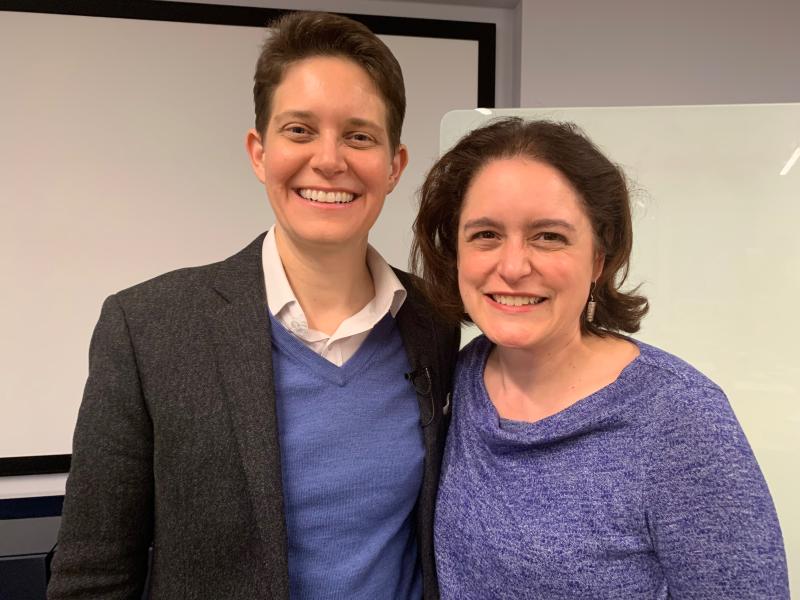
With Dorie

In case you would like to read the article in which I quoted Dorie and Kelly back in March 2017, I’m reprinting it below:

Introverts make better networkers.

That’s what J. Kelly Hoey, author of Build Your Dream Network, told a packed room of lawyers and investment professionals at the New York City Bar Association in late January of this year. After interviewing numerous sources for her book who are highly effective networkers, she realized that many of them self-identify as introverts.

The idea that introverts can truly shine at networking strikes many professionals – including many introverts – as a foreign concept. If they prefer being alone to lighting up a room and are driven more by introspection than connection, how can introverts be great at networking? After all, extroverts more easily strike up a conversation, keep it going and follow up with less fear. By their nature, they crave interactions with others. So how are they not the best networkers?

To get to the right answer, we need to be asking the right question, and that is: “What is the purpose of networking?” Effective networking, after all, is not an exercise in having the most Twitter followers or connections on LinkedIn. It is not, in fact, a numbers game at all. The goal of networking is to build an interconnected group (i.e. network) of individuals with whom you can create – over time and with meaningful energy invested – mutually beneficial relationships. A smaller network of more powerful relationships has infinitely more value than a so-called Rolodex of people who are weak contacts at best.

If you are looking for a place to start, remember that everyone already has a network. Everyone on the planet, in other words, has fellow alumni from high school, college, professional programs, work colleagues, neighbors, family, friends and/or other groups of people who form a network. Add to this basic network the people you may meet at yoga, tennis, church, the public library, nature walks, car shows, birthday parties or the myriad of other activities that may populate your day, and you may already have hundreds or even thousands of connections. If you start to actively associate with those in your existing network with whom you have a professional affinity, rather than envisioning networking as something that “other people do” or “only others do well,” you will make that first step toward actively creating an integrated network that works for you, rather than only belonging to a passive one created by default, not design.

The key to tipping the balance is to reframe the act of networking. It does not need to be a business-card exchange in a crowded event with strangers – something Kelly calls “random acts of networking,” which is generally ineffective – but it instead can be seen as an ongoing project of building relationships. By their nature, introverts are very thoughtful about how and with whom they communicate, so although they may not network in as many settings with as many people, they are more suited to creating a greater return for their ongoing efforts.

So how, as an introvert, can you effectively network in a non-threatening way?

Just as you would invest your money wisely, you can target your time invested to achieve the greatest return on such investment. This means, as I said above, that you first understand why you are networking so that it is a purposeful exercise. Are you building a network for a career transition that you foresee undertaking in the next 12 months, for example? If so, you will want to network with people who are in your target field or have undertaken similar transitions, who can help you along your way. Are you planning to write a book? You may wish to build a network of authors and experts in your area of writing, as well as others who are at the same stage in your writing journey, so you can support and share ideas with each other.

On a practical level, Dorie Clark, author of Reinventing You and Stand Out: How to Find Your Breakthrough Idea and Build a Following Around It and a self-proclaimed introvert, has great advice for other introverts who wish to grow their networks. As she offered in an interview with Forbes contributor Kathy Caprino: “There are plenty of new and interesting people to meet who already have some connection to you, so ask for suggestions from friends and colleagues about who they know that they think you should connect with.”

Connecting with warm contacts, in other words, is a good place to target your networking efforts as an introvert. As Dorie says, you will already have a starting point, and the common ground will allow you to build a professional relationship more quickly. In addition, if you grow a network through current connections, your target networking audience will be hand-chosen rather than arbitrary leads, so they are likely to be better matches in any case.

This emphasis on warm connections does not suggest that introverts should avoid conferences and other big-ticket events altogether. Rather, in their characteristically thoughtful way, introverts can carefully choose and plan a limited number of events that are likely to bring results and how to achieve them.

As I mentioned in my own book, Master the Interview: A Guide for Working Professionals, to network effectively, you need to show that you actually value the other person. Many people miss this crucial point, which is one reason so many introverts (as well as ambiverts and extroverts) have formed a negative impression of networking. They have been “networked to” rather than “networked with,” and (wishing to escape further uncomfortable interactions such as those in the past) have turned off to networking altogether.

Showing you value the other person by focusing on the relationship – and not what you can “get out of them” – can transform networking from what may feel or seem like a selfish, needy or transactional endeavor to a fundamental human connection among people who can enhance each other’s lives. With this end in mind, introverts, as well as extroverts, can create a network that works for them.

Anne Marie Segal is an executive coach, resume writer and author of two well-received books on interviewing and career development. She served as a corporate attorney for 15 years before launching her coaching practice, including roles at White & Case LLP and a hedge and private equity fund manager. Anne Marie is based in Stamford, CT and serves an international clientele. Her online learning platform is accessible here.

This article, other than the introduction, was original published on Forbes.com and is accessible here. Image above copyright 2019 Anne Marie Segal. All rights reserved.



Guest Speaking at Lehman College and Why “Buy Low, Sell High” Also Works for Recruiting

Late last month, I was honored to present to two classes at Lehman College as a guest speaker on career development. 

Handsome Hispanic Student Uses Laptop while Listening to a Lecture at the University, He Raises Hand and Asks Lecturer a Question. Multi Ethnic Group of Modern Bright Students.

There was considerable diversity among the student body in all senses of the word, including their professional goals. Some wanted to go the entrepreneurship route, while others were focused on tax, audit, financial advising and other “traditional” paths. In each case, we focused on their value proposition and how they could articulate to a target audience what they brought to the table.

We had some surprisingly in-depth discussions, and many of the students articulated a subtle and sophisticated understanding of themselves, their goals and the world at large. And, of course, we stretched them a bit further during the course of the presentation.

For example, one entrepreneurial student said his value stemmed in part from getting someone the “best deal.” We discussed the downsides of competing on price, because someone can always undercut you, so you will be sacrificing profit margins in order to win customers. We also explored how to extend the concept of service and relationship-building to make sure the “best deal” is more comprehensive than low-cost merchandise.

Another entrepreneurial student proposed creating and offering a specialty hair product for a niche market, and we explored what relationships she might need and want to build with scientists, investors, patent attorneys, social media influencers and others to bring her product idea to fruition and distribute and market it to her target audience.

We also discussed how presenting yourself in a job interview requires the same set of skills: understanding your value to the hiring company or client (i.e., what are the needs for that job or consulting engagement?) and how to best articulate your value (ability to meet those needs and exceed expectations) to your target audience. These concepts echo points I have raised in my books, Master the Interview and Know Yourself, Grow Your Career and are the key means to breaking down a daunting job search or other career decision-making process into manageable steps.

Each time I speak to a group of students, I am reminded that questions arising at the beginning of one’s career often continue to arise over the years. Many of the concerns these students had – such as confidence-building and personal branding as well as how to seek out, choosing among and making a positive impression on potential mentors and hiring managers – are similar those I hear from my executive clients.

As I imagine some of the readers of this post will be Lehman College and other students, I wanted to close with an article I read recently in the Harvard Business Review that is particularly apropos to job candidates at the beginning of their careers, entitledWhy Hiring is a Lot Like Picking Stocks.” (The specific classes were corporate finance and investment analysis courses, so the analogy is even more relevant to this particular group of students.)

I love that this article puts the hiring process in the same light as investment decisions, translating concepts such as due diligence, valuation, growth potential and other terms. As career coaches, we consistently try to help job candidates see beyond themselves to the goals of the team that will be hiring them. This article goes a long way toward making that clear in terms of the return on investment companies expect from job candidates, the risk-reward ratio that they consider when looking for new (or even experienced) talent and the delicate calculus that goes into talent retention.

And, by the way, if you are reading this and looking for a new source of recruits or investment opportunities, consider giving Professor Gary Jacobi a call. He just may have some suitable candidates for you!

Anne Marie Segal is an executive coach, resume writer and author of two well-received books on interviewing and career development. She served as a corporate attorney for 15 years before launching her coaching practice, including roles at White & Case LLP and a hedge and private equity fund manager. Anne Marie is based in Stamford, CT and serves an international clientele. Her online learning platform is accessible here.

Image above: Adobe Images.